


Cable chain
 A Cable chain is the most classic and recognizable chain style. It consists of a series of uniform oval links, usually made of round wire, each one passing through the next in an alternating pattern. A very fine cable chain, called a trace chain, is used in bespoke jewelry. Because the links are all the same size and shape, a cable chain looks clean and well-balanced. That’s why it’s the default choice for pendants because it doesn’t compete with whatever hangs from it.
Rolo chain
The Rolo chain is one of the smoothest old chains, often called “liquid,” and features small, circular, barrel-shaped links. Rolo chains are among the strongest chain styles available. The Rolo chain belongs to the same family as the Belcher chain. In terms of durability, the Rolo chain is moderately strong and well suited to support valuable pendants. The round links are sturdy and less likely to break than other chains, such as cable chains or curb chains. Rolo chain is also relatively thick, which adds to its durability.
Curb chain
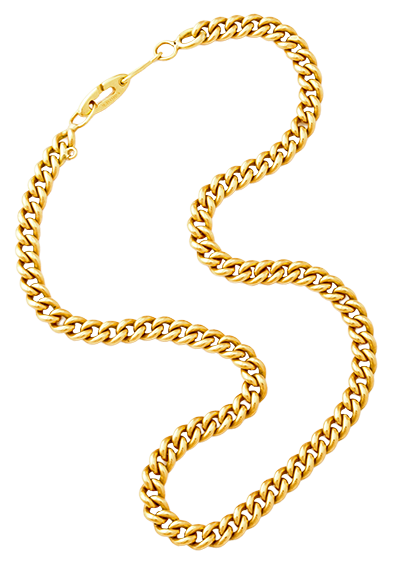 A curb chain is made of oval or rounded links twisted, or “curbed,” to lie flat against one another, rather than positioned at 90 degrees to one another, like a cable chain. Each twisted link overlaps the next, giving the chain its smooth, even surface. A well-made curb chain sits flat against the skin like a ribbon of metal and reflects light evenly across its face. Many curb chains are worked over with a faceting tool to create bright, reflective planes called diamond-cut. This adds a lot of sparkle without adding stones, and it’s a big part of why curb chains read as bolder and dressier than cable chains.
Cuban link
 A Miami Cuban consists of thick, heavy-gauge wires coiled as tightly as Che Guevara’s ass when Fidel was behind him, so each link nests directly into the next link’s shoulder, leaving zero space between links.
At its core, a Cuban link is a recent mutation of the traditional curb chain, a design that has existed for centuries to curb straps under a horse’s chin.
It crossed over into the men’s pocket watch chain market and gained popularity in the late 1970s, largely driven by hip-hop cultural icons: delinquent thugs and macho alphas (sometimes the same person).
It goes well with a muscle shirt and matching grilz. Conspiracy theories firmly link the Cuban link chain to the mother of a former Canadian Prime Minister, who allegedly used it to strap Castro’s face bush.
Franco Chain
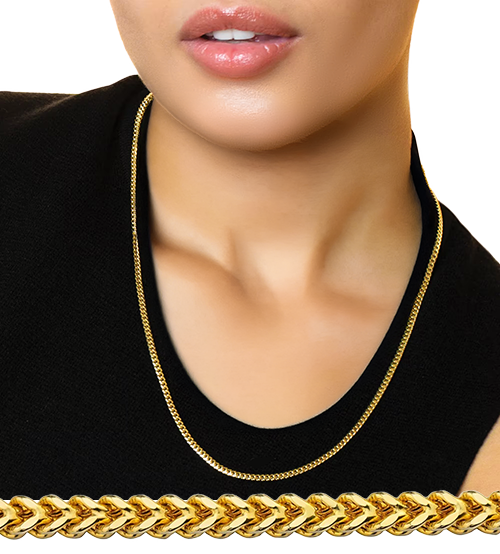 A Franco chain is a heavy, tightly woven chain made of V-shaped or U-shaped links that loop through several others, forming a dense, rounded square strand with a knitted look, like a strand pulled from an old sweater. Franco links are packed tight, giving the chain its weight. For that reason, Franco is among the strongest chains, perfect for hanging an enormous pave-encrusted dollar sign. The Franco chain is named after an Italian jeweler credited with developing the design, not the Italian word franco, meaning “free” as many people assume.
Rope chain
 The Rope is a durable braided chain with a rigid, tightly knit design, popular among jocks and beatmakers. It is made of small connected links arranged in a continuous spiral pattern. Each link interlocks with the next two, forming two strands wrapped around each other in a spiral pattern that recreates the look of a twisted rope. Its multiple surfaces throw light from different directions, giving the chain its characteristic brilliance. Rope chains come in solid, semi-hollow, and hollow styles, made from round, oval, or faceted wires of various thicknesses. High-density, heavier versions suit urban fashionistas, while finer, delicately woven examples offer a lighter option for DINKs. Despite its intricate appearance, a well-made solid metal rope chain has excellent flexibility and tensile strength. It is considered the most durable chain design capable of withstanding bar fights and domestic disputes.
Figaro
 The Figaro chain is a variation of the curb chain, built on a repeating three-short-one-long link pattern that adds variety and rhythm. Although the traditional arrangement is three-to-one, variations with different link proportions and sequences are also produced. Each link is a twisted metal loop, interlocked with its neighbors, then flattened and usually diamond-cut or polished. The links lie in a common plane, allowing the chain to drape flat against the skin. The Marriage of Figaro and Figaro chains both share strong associations with Italy. The opera’s punchy comedy mirrors the chain’s quick-shifting links, although the name’s exact origin is not well documented. The chain style became popular in the late twentieth century and remains one of the top chain styles. A modern diamond-cut finish adds facets and reflections, while traditional, polished links emphasize the chain’s outline and repeating pattern. This simple modification of a curb chain gives it a distinct, easily recognizable identity.
Anchor or Mariner

An anchor chain, also known as a mariner chain, is a chain composed of uniform oval links, each featuring a short crossbar across its center. The links interlock at right angles, creating a pattern inspired by the heavy chains used to secure ships’ anchors.
The central bars are not merely decorative; they reinforce the links and help prevent twisting or deformation under tension. In jewelry, the links are usually made from gold or silver and may be polished, flattened, or given a diamond-cut finish. Mariner chains range from delicate necklaces to substantial, bold-link designs. The name directly references maritime anchor chains, whose distinctive construction has been adapted into one of the most recognizable jewelry chain patterns. A variation with especially prominent, flattened links, called a Gucci chain, was adopted by the House of Gucci as its corporate symbol of unabashed capitalist greed.
Foxtail chain

A foxtail chain is a flexible chain made of closely interwoven, slanted links arranged in a repeating chevron-like pattern. It looks like a fox’s bushy, tapered tail, especially after a few drinks. The links are densely woven with a distinctive diagonal texture. Unlike a conventional cable chain, which consists of individually visible oval links, a foxtail chain has a more continuous, almost braided appearance. It can be produced in different widths and thicknesses. Despite its intricate construction, the foxtail chain is not particularly sophisticated in appearance. Its repetitive pattern tends to produce a rather busy visual character. Its busy texture and conspicuous shine rarely suggest refinement or understated luxury. It has a proletarian aesthetic, especially thick, highly polished, and worn as a conspicuous gold necklace.
Round Link

The Round link chain is similar to the cable chain and belongs to the same family as the Belcher chain. Unlike cable chains, which have elongated oval links, round link chains use circular links, as the name suggests. The distinction may seem minor, but it changes the chain’s visual rhythm and the way light plays across its surface. Each link slides through the next, forming a continuous, flexible strand. Links can be uniform in size for a simple, understated look or graduated to create a more decorative effect. Their proportions, wire thickness, and spacing determine the chain’s flexibility, weight, and overall character. Round link chains are among the oldest and most versatile chain constructions. They are used for necklaces, bracelets, and pendants, either worn alone or as a dangling part.
Snake or Brazilian chain
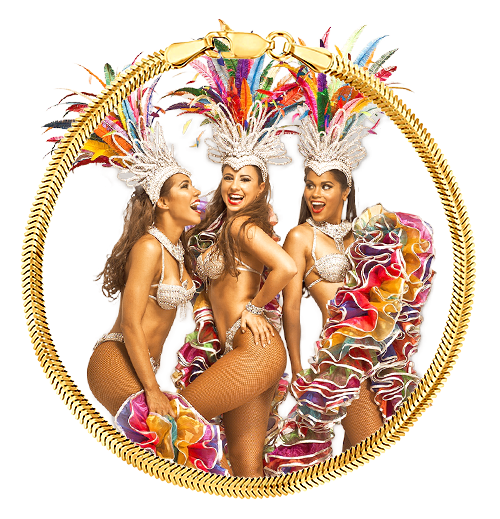 A snake chain is made of many small, curved metal plates or rings fitted tightly together to form a smooth, flexible belt. The links are so closely connected that you can barely see where one ends and another begins. The result looks more like a shiny, almost liquid snake run over by a truck. The chain has a smooth, solid surface that reflects light beautifully, like a river of mercury. The Brazilian chain is essentially another name for a snake chain, although the term is sometimes used for slightly different variations of the same design. Snake chains are usually made in gold, silver, or stainless steel. They look particularly attractive without a pendant, because their smooth surface is the main attraction. Snake chains aren’t particularly resilient when bent, twisted, or crushed. If kinked, they are impossible to fix. Don’t wear one to a carnival.
Wheat, Spiga, or Palm
 The wheat chain, also known by its Italian name Spiga, is a tightly woven assembly of miniature, interlocking links arranged in a complex repeating four-sided pattern. The links bend and interlace in alternating directions, creating a continuous series of V-shaped elements. This design offers flexibility and structural integrity with a consistent pattern resembling ears of wheat or braided stalks running along the entire length. The name Palm chain is another trade designation for this construction. Unlike traditional chains, assembled from individual links lying in a common plane, the wheat chain has a three-dimensional structure. Its links overlap at several angles, producing a compact, nearly tubular profile with a finely braided surface. They are dense and feel more substantial than they look, so even relatively fine examples have a pronounced presence and hold a pendant well. However, the intricate link arrangement makes repairs and resizing a pain in the ass.
Belcher Chain
 The belcher is an old-fashioned chain design that has been around for generations. It is a string of identical, round or slightly oval links connected end to end. Each link looks like a tiny bagel: thick, relatively wide, and usually round or D-shaped in cross-section. A belcher chain has a lumpy, sumptuous look with a posh, sturdy appearance like miniature shiny life-preservers.
The links can be either round or flattened, often made in yellow gold, although white gold and platinum versions are also available. Its appearance is reminiscent of a rolo chain, although rolo links are half-round and hollow.
Herringbone Chain
 A herringbone chain is essentially a stiff ribbon with little structural depth and no visual texture, pretending to be a chain. It is a flat, tightly woven ribbon of short, angular links arranged in parallel rows in a zigzag pattern.
It has neither individually discernible links nor the dynamic three-dimensional geometry of traditional chains. The mesh of interlocked V-shaped links, notoriously prone to kinking, runs in alternating directions, producing a fish-scale appearance. It lies completely flat against the skin and is usually brightly polished. One unfortunate bend can permanently kink the chain, leaving an unsightly, impossible-to-repair crease. Herringbone chains gained considerable popularity during the disco era of the 1970s and 1980s, when bigger, flatter, and shinier gold jewelry was very much in fashion.
Byzantine Chain

The Byzantine chain is an intricate link construction interwoven in a repeating, symmetrical pattern. It was sometimes called the Etruscan chain, Birdcage, Bird’s Nest, or Fool’s Dilemma. The chain’s description is as Byzantine as the chain itself:
“Unlike a conventional chain, where links connect in sequence, the Byzantine four-in-one weave folds link pairs back, securing them with another pair of loops of the preceding assembly and locking them into a tight, multidirectional arrangement.”
The result is a cushion-shaped cross section with several layers of overlapping links with a tightly meshed surface. The completed weave is dense and heavy, yet flexible enough to bend naturally. It is much more complicated to make than a simple cable or curb chain. The connection to the Byzantine Empire remains uncertain. It would be misleading to claim that Byzantine weave traces directly to a particular Byzantine workshop. The modern name generally refers to the weave’s convoluted, old-world appearance rather than a documented origin. The pattern has no direction, making it suitable for necklaces and bracelets shifting freely on the body.
Gourmette chain

The Gourmette chain is the fancy French name for an ordinary curb chain – a succession of oval links, each twisted 90 degrees and flattened. The chain lies flat against the skin just the way the French like it. The term Gourmette comes from French and refers to the chain used in horse tack to curb bridles. Jewelers have adapted the same basic construction for jewelry for centuries, and it remains one of the most widely used chain patterns. Gourmette chains come in yellow, white, and rose gold, as well as silver and platinum, in many widths and link proportions, with heavier versions often used for bracelets and necklaces. The simple link arrangement makes the chain relatively straightforward to manufacture, maintain, and repair. Its flat construction also makes it suitable for wearing close to the skin, either by itself or with a pendant.
San Marco chain
 San Marco is a distinctly decorative chain, with a retro Italian chic. It is distinguished by its closely interlocking, rounded links arranged diagonally, resembling a three-strand marine rope. From the side, it reveals a sequence of smooth, domed segments that are flat on the bottom and resemble a thick coiled cord sliced in half. Unlike ordinary cable chains, San Marco links are hollowed-out components connected by concealed, hinge-like joints, allowing movement while maintaining their characteristic profile. The hollow construction adds significant visual volume without adding much weight or cost. Various finishes can be applied to the outer surface. The San Marco chain is an attraction in itself, so adding a pendant would be like buttering a slice of bread on both sides. The exact origin of the San Marco name is quite murky, although it is commonly associated with Venice and Piazza San Marco.
Singapore chain
 In the hierarchy of chain designs, the Singapore chain is a charming, feminine ornament with sparkle and little ambition beyond looking pretty. It is a rope-like chain made of flattened links in a single spiraling strand twisted along its length. The Singapore chain is commonly made in relatively fine gauges, so it is lightweight, flexible, and surprisingly brilliant. Its distinctive wavy surface shimmers with every move.
The Singapore chain works particularly well as a delicate necklace worn on its own without pendants. It has more texture and sparkle than its close relatives: rope and curb chains, but lacks their distinguished appearance.
Cardano or Boston Link

The Cardano chain takes its name from the same basic mechanical principle used in a Cardan joint, also known as a universal joint. The connection is associated with the Italian mathematician and physician Gerolamo Cardano (1501–1576). A Cardan joint is a mechanical coupling that connects two rotating shafts at an angle, allowing them to transmit motion even when they are not perfectly aligned. The same general idea of interconnected, articulated parts gives the Cardano chain its name. A Cardano chain is made of a series of links with a distinctive, slightly twisted appearance. The links are usually flattened and arranged so that the chain lies comfortably against the skin. Cardano chain is not a miniature transmission, and its links do not reproduce the actual mechanism of a universal joint. The name is a reference to the mechanical concept, not proof of a direct engineering connection.
Prince of Wales Chain
 Also known as the Loose Rope, the Prince of Wales chain is a more open and flexible variation of the conventional rope chain. Its construction consists of small, rounded wire links, each interwoven with four neighboring links. The pattern is repeated along the length of the chain, in a continuous spiral structure. The difference from an ordinary rope chain is in the spacing. The links are not packed tightly together, allowing greater movement and a softer drape. The resulting surface has a more open texture, with individual links remaining visible rather than merging into the dense, braided appearance of a conventional rope. The name has an appropriately aristocratic ring, although its precise connection to British royalty is difficult to establish. The style was already in use in England around the turn of the twentieth century. Surviving Edwardian examples, circa 1901–1915, include both short necklaces and long guard chains. The latter could be worn hanging almost to the waist or wound several times around the neck.
Figure-eight or Infinity-link
 Bridging the gap between the utilitarian simplicity of a cable chain and the heavy intricacy of a rope, the figure-eight chain offers an effortless balance of structure and movement. Its signature silhouette relies on an alternating sequence: classic round or oval links interspersed with pinched, twisted links resembling the numeral eight or the infinity symbol, if you are Chinese. By shifting the orientation of every second link, the chain avoids the flat uniformity of a basic link structure. Forged in dense, resilient platinum, links are formed one by one and fused rather than stamped, resulting in crisp edges, fluid drape against the collarbone, and superior tensile strength. It carries enough visual presence to be worn alone, yet remains understated enough to support a fine pendant without competing with it.
Paperclip or Elongated link
 A paperclip chain is made of a series of long, narrow, racetrack-shaped links that look remarkably like ordinary paperclip outlines, hence the name. Unlike traditional chains with small, rounded links, paperclip chains have an open, airy appearance that makes their structure easy to see. The links can be thin and delicate or thick and substantial. Paperclip chains are pretty cool when they are worn alone, layered with other necklaces, or decorated with charms. Their primitive, industrial look gives them a modern feel without requiring complicated workmanship.
Book Chain

A book chain is a jewelry chain made of a series of flat, rectangular, or slightly curved links resembling the pages or covers of a small book. Each link connects to the next with hinges or small connecting rings, allowing the chain to articulate while retaining a substantial, structured appearance. Book chains are typically made in gold or silver, often with polished surfaces, engraved decoration, or repoussé ornament. Their broad, flat links create a distinctive architectural look, unlike the fluid appearance of conventional wire-link chains. Popular during the Victorian era, particularly in the 19th century, book chains were used for necklaces, bracelets, and watch chains. Their substantial construction made them both decorative and durable. The name comes from the resemblance of the individual links to the covers of tiny books.
Popcorn or Coreana chain
 A popcorn chain, also known as a Coreana chain, is a lightweight chain made of hollow, petal-like links. The links are shaped and arranged to create a continuous, rounded, layered surface with a distinctive pebbled texture. Despite its seemingly substantial volume, a popcorn chain is surprisingly lightweight. The links are delicate and can be easily crushed, kinked, or permanently deformed if the chain is pulled or bent sharply. Popcorn chains were particularly popular in the 1980s and 1990s, when people abandoned good taste and common sense. Their resemblance to clusters of exploded kernels explains the name, although the overall effect is a mixture of bark skin and fish scale.
Bismark or Cascade chain
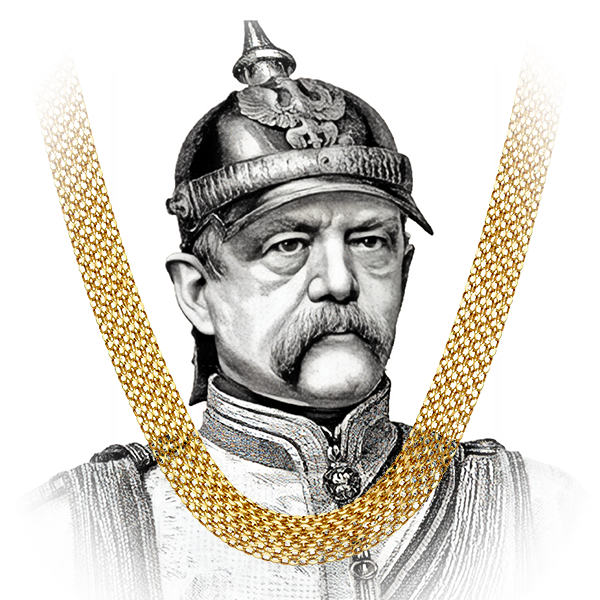
The Bismarck, or Cascade chain, a perennial Russian favorite, is half chain and half necklace. It has a dense, intricate, multi-row woven arrangement of links running in a repeating, symmetrical pattern. Unlike simpler chain styles built around a single row of links, the Bismarck uses overlapping elements that repeat in several directions to create a wide, domed ribbon of metal. It consists of individual wire loops interlocked in several directions. Depending on the particular variation, the construction may incorporate multiple rows of links, creating a compact structure with considerable visual density. The name Bismarck is particularly associated with European gold chain manufacturing, especially Italian and German jewelry traditions. The name Cascade is sometimes used for related multi-link constructions, although terminology varies among manufacturers and markets. These names do not always describe one standardized link arrangement. Depending on the weave and finishing, the surface can appear almost woven. The construction is more labor-intensive than that of conventional curb or cable chains. Its tightly interconnected links create a relatively rigid structure, and repairs require attention to the original weave to preserve the pattern’s continuity.
Parallel Link Chain
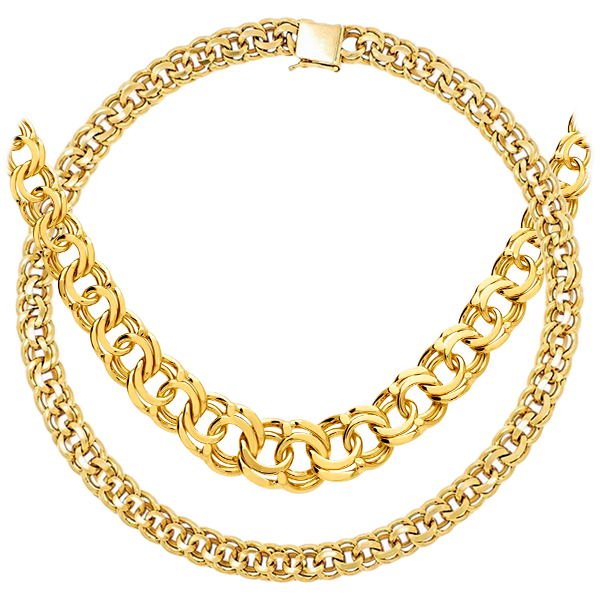 A parallel link chain is made of a series of identical metal links arranged side by side in parallel rows, rather than alternating conventionally. Each link connects to its neighbors through small connecting rings or joints, creating a flat, broad chain with a repeating, ladder-like pattern. Imagine several jump rings side by side, all pointing in the same direction. Sandwich them together, repeat the arrangement, and you have a parallel link chain. The construction produces a relatively flat chain with a decorative appearance. Depending on the design, the links may be rectangular, rounded, or elongated, and the finished chain can be polished, textured, or diamond-cut. Parallel link chains are primarily decorative. Their doubled-up surface can make you feel like you’ve had too many drinks.
Panther chain

A panther chain is a flat, multi-row strap chain built from staggered, brick-like rectangular or slightly domed links. Rather than looping end to end like a cable or curb chain, the links are offset against each other in parallel rows like masonry. Internal pins or hidden cross-bars join the links horizontally, allowing them to articulate vertically while resisting lateral twisting. Every link is milled to tight tolerances and pre-polished before assembly; any irregularity in height or tension disrupts the even mirror plane across the top. Because the links lock closely together with minimal air space, a panther chain feels heavy, lies flat against the body, and moves like a smooth, shiny ribbon. The panther chain is structurally self-contained. Hanging a heavy bail on a multi-row flat band pinches the central links and ruins its drape. In European workshops and vintage trade catalogs, the panther link is frequently called a brick link (maille brique) because its staggered rows mimic running-bond brickwork. Louis Cartier couldn’t resist the temptation to make this chain style his own and nicknamed it “La Panthère” for its fluid, feline flexibility. The Panthère chain reached peak popularity in 1983 with the debut of the Panthère de Cartier wristwatch, whose five-row flexible bracelet became an immediate hit.
Crisscross chain
 A crisscross chain is made of links arranged in alternating directions, creating a repeating pattern of diagonal crossings along the chain. Each petal-like link passes through and overlaps the adjacent one at an angle, creating a fluffy appearance similar to, but more hideous than, a popcorn chain. Unlike a conventional cable chain, where individual links remain clearly separated, the crisscross chain forms a continuous mesh of intersecting metal surfaces. Depending on the design, the links may be relatively flat or slightly rounded. Its distinct feature is a sequence of crossing links rather than a simple succession. The arrangement gives the chain a distinctive texture and a relatively consistent appearance from different viewing angles.
Bamboo chain
 Let’s not get fooled – the bamboo chain is really a necklace, not a chain, although its ancestor is a station chain. Hollow tubes replace wire loops with flared, bulbous ends sculpted to resemble a segment of a bamboo stalk. They are joined by concealed ball joints. Because of the tight clearances between rigid segments, the chain articulates in a jerky motion rather than a smooth wave of traditional chains. The bamboo links are usually die-struck; mass fabrication gives the nodes sharp sculptural form without any need for artistry. The bamboo motif was spurred by the Japonisme movement following the opening of Japanese trade ports in the 1850s. The form saw two major revivals: first during the Art Nouveau era around 1900, when organic botanical forms dominated high jewelry, and again in the late 1960s and 1970s, when garish Gypsy aesthetics became staples across Paris, Milan, and New York.
Bar-Link Chain
 This is the easiest chain to identify: rigid, elongated bars separated by articulated connections. The metal rods of various profiles, typically straight, solid, or hollow, are joined by simple jump rings on the narrow end.
More elaborate versions use flattened, rounded, twisted, or faceted bars, with variations in their length, thickness, and cross-section. The connecting jump rings are in the same plane as the long bars or angled for a more articulated look. The chain has a distinctive Art Deco feel, especially with a textured or hand-engraved finish. The bars themselves are relatively rigid, while the connecting rings concentrate movement at specific points. As a result, the chain’s flexibility and resistance to deformation depend heavily on the make.
Railroad chain
 The railroad chain is made of repeating parallel links and cross-ties. The links could be made of wire or stamped parts and arranged in a flat or slightly rounded ribbon that resembles a railway track or a bicycle chain.
Railroad chain is not a standardized design, and the name can refer to various link combinations, so relying on the trade name alone can be deceptive. Available in different widths and alloys, railroad chains are usually worn without pendants, keeping their distinctive look unobstructed. Their appeal lies in the pattern’s regularity and the contrast between the parallel and transverse elements. It’s more of a necklace than a chain.

Ladder or Hook Chain
The hook chain, also known as the hook-ladder chain, is made of a succession of U-shaped links, each with a rounded end and an opposite end narrowed and folded back into a hook. Each link’s hook catches the rounded end of the next, producing a distinctive repeating pattern. Viewed from the front, the rounded parts look like ladder rungs, while the folded ends make up the articulated hinges. Its profile is neither entirely flat nor fully round. There is a slight resemblance to a ladder, although it is more apparent in the link arrangement than in the overall silhouette. The alternative name, hook chain, refers more directly to the mechanics holding the links together.
People often mix up weave ladder and railroad chains because both rely on parallel tracks and cross-pieces. The difference lies in how rigid the outer parts are. A weave ladder is a knit necklace in which two parallel strands of any basic chain, such as curb or rope, are joined at regular intervals by short, perpendicular cross sections of the same chain, like a miniature climbing ladder. The rungs span the gap, turning the structure into a flat, open-frame grid with a negative space between every step. The geometric grid was a favorite of modernist design philosophy popular during mid-century modern minimalist jewelry, when net-like designs were in high demand.
Nugget chain
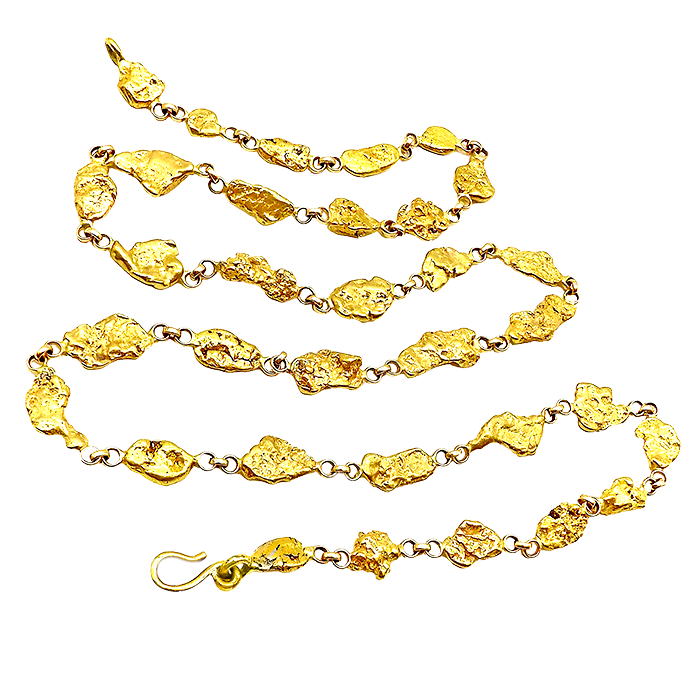 The Nugget chain gets its name from small, irregular lumps of naturally occurring gold strung together. Modern variations are made from fabricated bead-like clumps of gold or silver, never platinum. Each bead is cast or hand-hammered to resemble natural gold nuggets and twisted to join the next. The links have an uneven, crude look, and because zero skill is required to make one, the nugget design is a darling of amateur “designers.” The chain style points to the history of gold prospecting during the nineteenth-century gold rush. Naturally occurring nuggets were prized for their rarity and distinctive appearance. Their irregularities offer windows into unique geological formations, an accident of nature as a recognizable element of a primitive jewelry style.
Box or Venetian link
 A box chain is made of cube-shaped links joined into a smooth, continuous strand, like a line of tiny boxes or a four-sided tube. The links interlock at a right angle, giving the chain its mechanical, industrial look. Because the surfaces are flat and uneventful, the chain reads as part of steampunk machinery.
The Venetian chain is essentially the same thing, so the terms are often used interchangeably. Chains with elongated, rectangular boxes, sometimes with a bit more heft, are often called “Venetian.” Box chains don’t kink or tangle as easily because their rigid links resist sharp folds. They are smooth, so they don’t snag on clothing, but they’re harder to repair than a cable chain.