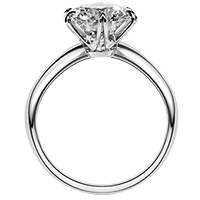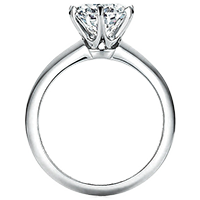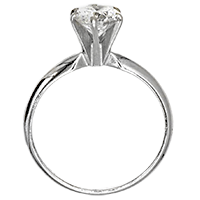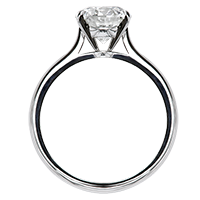




Six-prongs vs Four-prongs
A modern engagement ring does not require more than four prongs to hold a diamond securely. In fact, four prongs are more than sufficient, and in a well-engineered setting, even two prongs can provide adequate retention. Contrary to popular belief, a six-prong setting is not inherently safer than a four-prong design.
The additional prongs in a six-prong crown-style setting are simply for redundancy. Because these settings lack the lateral support provided by the upper bezel found in basket settings, the extra contact points help prevent the prongs from shifting sideways. By distributing the holding grip across more prongs, the setting is less likely to loosen if subjected to an impact.
So why does the classic six-prong Tiffany solitaire remain so popular? The answer is simple: tradition, reinforced by more than a century of relentless marketing. Does “Breakfast at Tiffany’s” ring a bell? Turning a two-hour infomercial into a cherished American movie classic is a remarkable feat.
A six-prong crown setting is aesthetically different from much more dominant four-prong brethren. Six evenly spaced prongs closely follow the circular perimeter, naturally guiding the eye around the stone and making the prized round cut easily recognizable.
For those who appreciate the look of a crown-style setting, a Tiffany-inspired solitaire remains a beautiful choice. However, if the appeal is based on perceived security rather than appearance, a four-prong basket setting is often the better option. It is equally secure, more contemporary in design, traps less grime, and exposes more of the diamond to view and light.
Gestalt Principle of Visual Perception In Action
The number and position of prongs directly influence the shape of a diamond. At a casual glance from a distance, the diamond shape in the ring is not always obvious, so the brain uses the Gestalt effect to reconstruct it from the most salient visual clues: the prongs. Unable to clearly see the diamond silhouette, the brain connects the prongs to fill in the missing information, solving a dot-to-dot puzzle.
Jewelers use prong placement to refine or correct a diamond’s perceived shape. For instance, moving prongs toward the tips of an oval diamond makes it look more slender. Four double prongs will make a small round diamond appear cushion-shaped, while six prongs will emphasize its round shape.
At the end of the 19th century, as diamonds transitioned from square to a more fashionable round shape, jewelers began arranging multiple prongs in a circle to articulate the circular shape. The greater the number of prongs, the stronger the visual effect. Antique rings often relied on multiple prongs to make irregular diamonds appear round.
There was a trade-off. Too many prongs obstruct light and conceal a significant portion of the diamond’s surface. As diamond cutting continued to evolve, eventually allowing for the consistent production of perfectly round stones, jewelry settings evolved alongside it. Over time, the number of prongs was reduced to six, the absolute minimum needed to complement a round diamond.
Tiffany Solitaire without Tiffany the Company
The six-prong crown setting is not proprietary to any single jeweler. What Tiffany & Co. introduced in 1886 was a market category, not an exclusive design. Today, any competent jeweler can make a six-prong crown setting. Many do. Not all do it well. Even Tiffany’s own version, mass-produced by thousands, is not perfect.
The difference between a finely executed six-prong solitaire and an ordinary one is immediately apparent to a trained eye, though less obvious to the average consumer. Under magnification or in close-up photography, the distinction becomes unmistakable.
The quality of the proportions, the geometry of the prongs, the precision of the curves, and the overall finish separate exceptional craftsmanship from mass production. The proportions are carefully balanced, the silhouette is graceful, and every curve is calculated to create a harmonious relationship between the diamond and the mounting. While sharing the same underlying concept as the original Tiffany setting, the Tulip improves upon it in every aspect that matters.
The prongs emerge from the base at an exceptionally wide angle, creating a seamless transition from metal to stone. This geometry serves two important purposes: it allows the diamond to sit lower on the finger while minimizing the metal’s visual presence, and it exposes more of the diamond to view from every angle. The result is a setting that appears lighter, more refined, and more focused on the diamond itself.
We are an arthouse, not a retailer. Our priority is the ring’s beauty, not the marketing narrative surrounding the stone. We are not in the business of attaching a luxury brand premium to a familiar design. Instead, we devote our efforts to proportion, craftsmanship, and execution. That allows us to offer a superior six-prong silhouette that stands on its own merits, without the brand-name premium on a stone.
The Tulip™ The Architecture of Light
Our Tulip™ solitaire is the six-prong crown setting at its most refined. Its name is earned: viewed from above, the six prongs radiate from the base, then turn inward to grip the girdle, like tulip petals enveloping the stamen before bloom.
The prong tips are shaped into delicate points. Not the blunt, rounded knobs found on production rings cast in batches of a hundred. Each tip is filed and polished individually, so no two Tulip™ rings are completely identical. The slight variations are not a flaw. It is the signature of handcraft.
The Tulip™ is designed for round stones only. Fancy shapes with their irregular geometry and pointy tips require different types of settings, typically basket-style. We will advise on the most suitable setting style when we work with stones other than rounds.
Leon Mege Tulip™ is superior to any other crown-style setting, including the original Tiffany’s.
- Dramatic aperture angle of the setting
- Finely chiseled prong roots
- Clear spaces between the base and the prong roots
- Precise finish and fit
- Attention to every little detail
The base platform where the prongs originate is known as the gallery. It is proportioned to bring the setting roots as close together as possible, thereby increasing the cone’s aperture and minimizing metal visibility. In low-end production rings, prongs converge to a single point at the base, creating a structurally weak spot, a cost-saving shortcut. A well-made ring must have a gallery where the prong roots are attached. The roots should be bullet-shaped in 3D relief and clearly separated. A note on prong styles. There are different prong tips to choose from in order of popularity:
- Truncated tabs
- Hearts
- Claws
Heart tips are very unique and preferred by connoisseurs.
Choosing the Right Stone for a Six-Prong Setting
The six-prong crown is specifically designed for the round diamond. The prongs are spaced evenly at sixty-degree intervals around a girdle. The crown base is terminated with bullet-shaped triangular vanishing tips resting on a circular gallery. Unlike other rings, the top of the gallery is completely flat, so all six points could rest on it. This is not an aesthetic preference. It is a structural one.
The entire purpose of the six-prong crown is to maximize the diamond’s exposure to light. Setting it with a mediocre cut is the jewelry equivalent of installing fabric seats in a Rolls-Royce. The mounting will not compensate for a lifeless stone.
Idiotic misconceptions about Tiffany’s setting are deeply rooted in ignorance and a lack of professionalism among jewelers alike. Their rants are rampant among second-rate jewelers and retailers. Here are a few examples of patently false statements found on the web:
“A four-prong ring that loses one prong has lost twenty-five percent of its grip. A six-prong ring that loses one retains five-sixths of its hold.”
“Serious jewelers prefer the six-prong crown for stones above one carat, where the value of the stone warrants the additional insurance of the setting.”
| Leon Mege Tulip | Original Tiffany | Generic "Tiffany" | Winston Solitaire | |
|---|---|---|---|---|
|
|
|
| |
Setting type |
Crown |
Crown |
Crown |
Basket |
Stone security |
Very secure |
Secure |
Somewhat secure |
Very secure |
Setting height |
Low |
High |
Extremely high |
Low |
Metal Visibility |
Minimal |
Moderate |
High |
Minimal |
Number of prongs |
Six |
Six |
Six |
Four (Single or Double) |
Selling point |
Maximum diamond visibility |
Brand recognition |
Low cost |
Classic alternative to six prongs |
Shank style |
Blunt knife-edge |
Round or knife-edge |
Half-round |
Solid or Cathedral |