
Setting Stones Low
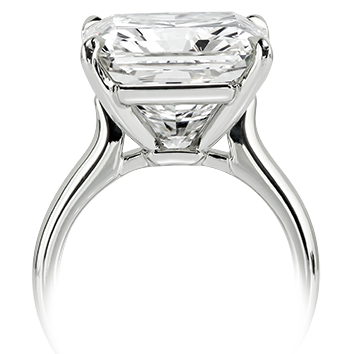 By default, all fine jewelry, the kind we make, is set “As low as possible”. It doesn’t mean we force the stone lower than the ring’s physical geometry allows; it means we try to minimize the ring profile as much as possible.
A properly positioned center stone highlights a critical distinction between high-end craftsmanship and primitive low-end assembly. When an artisan builds a piece by hand, setting a gem as low as physically and structurally possible is the foundational standard of proper fabrication. Superior craftsmanship means setting the center stone at the lowest point allowed by its geometry while preserving the ring’s proportions.
The ring height is measured from the stone’s table to the base of the finger. The stone’s measurements, especially its depth, have the biggest impact. Larger stones (typically over 1.5 carats) have enough depth for their culet to sit just above the lower gallery line. Smaller stones (1 carat or less) and shallow gems are generally raised so the ring doesn’t look flat as a pancake. In particular, a cathedral mounting with raised shoulders on a vertically split shank requires the center stone to sit higher. A large finger size can also push the stone up, especially in rings with side stones or cluster designs. A custom ring integrates the basket directly into the shank, lowering the stone. The low profile keeps the piece close to the hand, lowering the center of gravity. This reduces spinning around the finger and shields the prongs from daily bumps and bruises.
A ring built from off-the-shelf components has a prefabricated head sitting tall because it is welded onto a shank. High settings come from poorly trained jewelers and CAD designers trying to imitate fine jewelry without understanding the structural mechanics or having artistic talent. Consumers unfamiliar with fine jewelry may take that as the proper way to set the center stone.
Center Stone is Focal Point
The center stone is the main focus of a ring; the setting is just a pretty holder designed to present the stone in the best possible light. The gemstone is the main course, just like the steak on a dinner plate. Not potatoes, or, God forbid, ketchup. Loading the setting up with extravagant components in a desperate bid to make it look expensive signals that the design has lost sight of its main purpose. A ring is both a mechanical structure and an art object. Its setting should look effortless, like the diamond cannonballed itself right in the middle. The center stone determines the design, not the other way around. Its size, geometry, and shape dictate the setting’s precise construction and how much metal is visible from the top. Ideally, none, because it is hidden under the stone or shaped in a way that makes it less obvious.
There is a difference between a common ring that holds a diamond and a bespoke ring that presents that diamond beautifully, an exceptionally elegant mounting that knows its place. The setting can be a work of art in its own right, but if it is what people notice first, the jeweler has failed.
Curvatures and Angles Override Measurements
 Jewelry is not a collection of measurements. Its soul is curves, transitions, proportions, and how they work together. The measurements should follow the design, not dictate its red lines. Beauty results from the carefully managed relationships among curves, angles, and transitions. Changing one element will influence the appearance of others. If one is adjusted even slightly, the others also require adjustments, often leading to an unbalanced, poorly proportioned ring. That is why we prioritize curvatures and angles over arbitrary measurements, especially those requested by inexperienced consumers based on something they read online.
Curvature gives a ring its characteristic lines. It determines how surfaces flow into one another, how light bounces off the metal, and how the eye sees individual components. Elegant curvature relies on the visual beauty of modular geometric paths such as a logarithmic spiral. Its contours are shaped with deliberate transitions without any sudden breaks. Curves are difficult to reduce to numerical specifications because their success depends on the overall composition. A curve that looks beautiful in isolation may be entirely wrong when incorporated into a particular design. Its radius, direction, and visual weight must be judged in relation to the surrounding forms. The objective is not to make every component independently attractive, but to make the entire composition appear congruous.
Measurements Do Not Define Beauty
Two rings with slightly different measurements can appear nearly identical when their proportions and contours are properly balanced. For example, specifying a shank width can be useful technical information, but it may not fit a particular ring design. It says very little about how substantial or delicate the ring will actually look. For example, a rounded shank will reflect light differently than a flat one. It will look thinner even when it has an identical width. The same applies to prongs, bezels, galleries, and shoulders. Their beauty isn’t locked into isolated measurements, but in how their shapes relate to each other. Measurements describe a distance between two points, not the grace of a line connecting them.
Proportion Is More Important Than Measurements
Fine jewelry should not be designed around the assumption that every component must follow a standard dimension. Different center stones, finger sizes, and design configurations demand different solutions.
A mounting made for a one-carat diamond cannot simply be enlarged to accommodate a three-carat diamond and be expected to retain the same look. Increasing the stone size changes the visual balance and the relationship between the center and what holds it. Some elements must become more substantial, while others are reduced. The right dimensions preserve intended angles and curvatures while providing the necessary strength and durability, preserving the design’s soul. Proportion is not uniformity. It is the intelligent distribution of visual and physical weight. Fine jewelry is not about conformity to a pre-set measure. It is about a natural flow in every detail, visual harmony, structural integrity, and refinement of the ring. Getting it right requires experience, artistic sensitivity, and the willingness to make necessary adjustments, even if they differ from the agreed-upon measurement. A beauty cannot be engineered by numbers alone. Measurement is an unnecessary burden on the way to elegance and proportion.
Eagle-Claw Prongs
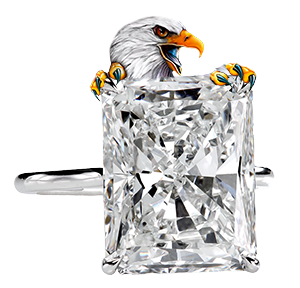 When we mention eagle-claw prongs, we mean tips that terminate above the girdle and are clearly visible from any angle. We are not concerned about the prong’s vertical shaft. Rounded or flat, it is an integral part of the setting, and its side view has minimal impact on the overall appearance. But any metal showing up on top has a dramatic impact on the ring’s appearance. Ideally, it should be invisible, but that is physically impossible. To minimize the metal’s visibility, the tips can take different shapes: claws, buttons, tabs, etc. However, most contemporary high-end mountings feature only Eagle-claw prongs. Here is why.
Claw prongs feature a high-ridge teardrop shape that terminates in a point, offering maximum holding power with minimal obstruction. Their reduced footprint area provides the necessary clamping force despite their smaller footprint. The claws’ reflections along the edge make the prong look thinner, similar to the optical illusion of a knife looking thinner when viewed from the blade side than from its spine.
Stones Secured in Seats
A gemstone should never be suspended in prongs when it can be properly supported by a properly prepared seat. Precision fitting is fundamental to the stone’s security and overall structural integrity. A gemstone should never be suspended in prongs when it can be properly supported by a properly prepared seat. Precision fitting is fundamental to the stone’s security and overall structural integrity. The seat’s position relative to the girdle is determined by the gemstone’s depth and faceting; it is established individually for each stone and each design.
 In the popular Tiffany crown-style setting, the diamond is held only by the tips of the prongs, without any support underneath the stone. The lack of a seat is compensated by an increased number of prongs – six instead of four. However, other prong settings, such as the traditional Winston-style classic solitaire, require stones to sit directly on the supporting structure known as the upper gallery or upper bezel. Its function is structural, not decorative: it provides a continuous, evenly distributed bearing surface on which the stone rests.
The bezel’s upper inner edge is carefully prepared by the setter to accept the stone. A properly fitted stone forms a tight, no-gap seal with the bezel. The bezel carries the load from underneath and prevents the stone from shifting, while the prongs secure the stone from above and prevent displacement. Fitting a stone by hand to match the pavilion precisely is one of the most time-consuming operations in high-jewelry making.
Prongs alone should not be used to hold the stone in midair; this is a clear sign of incompetent setting. A prong setting is a mechanical structure with a defined purpose for every component. The bezel or upper gallery provides the bearing surface, the seat establishes the stone’s precise position, and the prongs retain it. The quality of the finished setting depends on the jeweler’s skill and experience.
Tightly Packed Pave
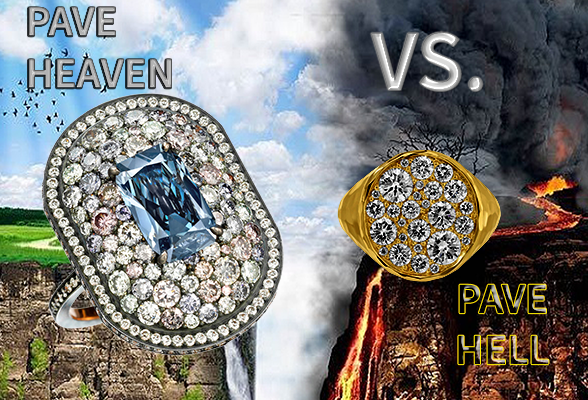 Fine pavé is distinguished not by diamond quality, but by how closely and precisely the stones are integrated into the mounting. A key marker of pavé quality is how tightly the stones are set. The objective is to create a continuous field of stones in which metal is minimized, and each diamond is securely held. Gaps between stones interrupt continuity, expose too much metal, and reduce the visual density of the diamond surface. A properly executed pavé is a closely integrated arrangement, not a scattered collection of individual stones. Achieving tight pavé requires talent. Each stone needs a precisely positioned bearing seat and enough pressure to embed securely.
Incorporating Ajour
The word ajour comes from the French for “a cutout”; it is a refined setting technique, a delicate skeleton piercing, intended to enhance the underside of a setting and remove excess metal. Historically, ajour became an important feature in jewelry making at the time when skilled labor cost less than the metal removed.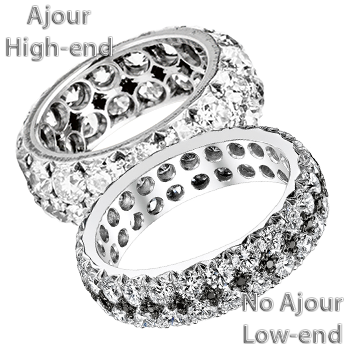 This traditional technique creates openwork by exposing the backs of gemstones framed in a lacy metal grid. In high jewelry, ajour is a signature of craftsmanship and a jeweler’s skill.
Ajour openings follow the contours of the stone seats. They must be carefully drawn and proportioned, with crisp edges and smooth interior surfaces. The saw scores on the ajour wall are identifying marks of a master’s handwork. In modern jewelry making, labor costs far more than metal, so cutting ajour by hand is not cost-efficient. Micro pave doesn’t need openings on the back because the stones are very small and tightly packed.
Ajour isn’t cut to let light in from the back, contrary to uneducated claims compiled by unhuman intellect from various websites. Jewelry sits against a person’s skin (except for drop earrings), and unless you are an elf, no light can possibly come through. Ajour makes jewelry cleaning easier by letting cleaning solutions and brushes reach under stones; however, unlike a smooth metal surface with no holes, ajour cavities trap dirt, soap residue, and oils beneath the stones.
Chamfered Edges
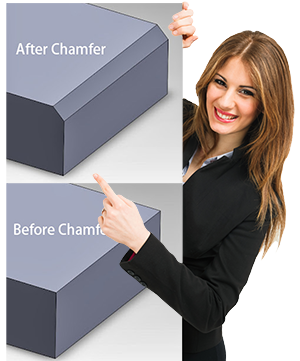 In bespoke jewelry, the craftsmanship is revealed by minor details that are easy to overlook. One such detail is the chamfer: a bevel that blunts a sharp edge where two surfaces meet. Seemingly minor, chamfering plays an important role in a jewelry piece’s appearance, finish, and comfort. It gives metal surfaces a refined, finished look, reduces metal bulk, and adds a softer feel to the piece. A chamfer is only as good as its execution. A crooked bevel, inconsistent angles, and poorly rounded transitions are immediately noticeable.
Precise Finger Measurement
 A fraction of a ring size can make a significant difference in how a ring fits, feels, and performs during everyday wear. Retailers treat ring sizing as an approximation and pay little attention to the finer increments that determine a truly comfortable fit. Fine jewelry sizes come in 1/8 increments of a US ring size, allowing precision beyond conventional full- and half-size measurements. A ring that is too tight is uncomfortable to wear. An oversized, loose ring may slip off or deform easily. The goal is not just to find the size that passes over the knuckle, but to balance comfort with security.
Only an experienced jeweler can determine the best size for the person. Finger size fluctuates every hour, day, week, month, and season, not to mention size changes during childbirth. Many aspects of ring sizing need to be taken into account. A wide band generally requires a different size than a dainty band because it contacts a greater surface area of the finger. A comfort-fit interior with its slightly rounded inner profile feels different from a flat interior even when both rings have identical nominal sizing. In bespoke jewelry, accurate sizing should be established before the mounting is fabricated. Changing the size after completion distorts the shank geometry and weakens pavé. Every size adjustment is minor surgery that could have been avoided with proper finger measurement.