
Cartier Rolling Rings: From Russia without Love
A rolling ring is a puzzle ring without a puzzle. It consists of several (usually 3 or 5) interconnected bands that form a single ring when assembled and collapse into a loose tangle when removed. It is a conversation piece.
The design dates back centuries to Turkey’s Halka-i-Sadakat and German Gimmel rings. 19th-century Russians wore three intertwined bands that moved freely inside one another, and, in typical French fashion, Louis Cartier misappropriated that original idea in 1924. Today, the design is known as the Cartier Trinity ring.
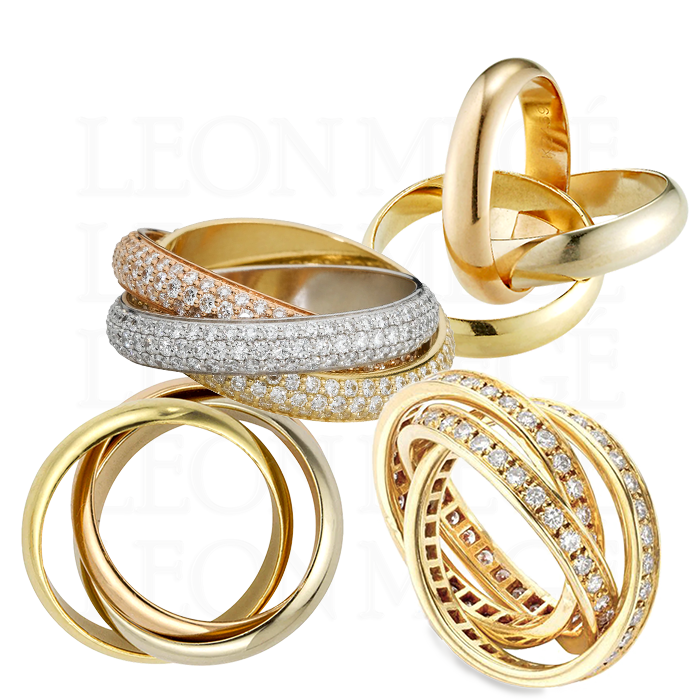 Cartier’s rolling ring perfectly illustrates how an existing concept owned by no one can acquire an entirely new commercial identity through branding, presentation, and protection by an army of copyright lawyers. Nearly a century later, the design remains one of their most recognizable products. Its lasting popularity confirms the trend: in jewelry, a gimmick matters more than elegance and beauty; the name on the box often matters more than what’s inside. Over time, Cartier expanded the collection to include a variety of combinations, including single-color versions or bands set with diamonds and gemstones. Cartier’s marketing linked each gold color to love, fidelity, and friendship. The symbolism helps boost sales, but the design is compelling even without it.
Three Rings in One
A conventional ring looks identical every time it’s on, but the rolling ring changes with each wear. The earliest versions combined yellow gold, rose gold, and platinum, much like their Russian predecessors. White gold later replaced platinum in the classic tri-color design. Depending on how the rings settle, one color may dominate the view, or all three may appear in a new arrangement. The band’s appeal rests on its ingenious construction and how the components interact with each other. Neither band can be removed without all three falling apart. The bands slide and roll over one another in one smooth action along the finger, making it easy to put on or take off. Yes, they will scratch one another in the process, but this is unavoidable. Once they’re all covered in scratches, you don’t notice new ones.
The History of the Cartier Trinity
 During the roaring 20s, jewelers were exploring new ways to blend geometric cool with artistic modernism. Rather than relying on gemstones or elaborate decorative motifs, the metal construction itself is the principal feature. Various accounts credit avant-garde French artist and future Nazi sympathizer Jean Cocteau as an inspiration to his friend and future French Resistance supporter Louis Cartier to replicate the well-known design. However, the precise details of that collaboration are not documented.
What is beyond dispute is the design’s longevity. Cartier has repeatedly reinterpreted the original concept through variations in size, finish, materials, and diamond accents. The essential idea remains intact: several independent bands hooked to each other in one harmonious whole. The Trinity celebrated its centenary in 2024, an impressive milestone for a design with such modest visual vocabulary.
Why Rolling Rings Remain Popular
The Trinity occupies an unusual position in the world of fine jewelry. It is instantly recognizable without depending on a prominent gemstone, and it works across a wide range of personal styles. Its combination of three gold colors also pairs easily with other jewelry, whether the wearer favors yellow, rose, or white gold. The design appeals to people who appreciate branded luxury, but also a playful quality that distinguishes the rolling ring from traditional wedding bands. Its dynamic structure looks good from multiple angles, and the bands’ movement adds tactile pleasure.
A Design Worth Giving a Try
The band reminds us that jewelry doesn’t always need expensive gemstones to justify its existence. Gold has its own color, weight, luster, and fluid forms. When these qualities are handled well, a simple metal ring can be every bit as engaging as an overly elaborate creation.
Of course, the Cartier name contributes to the ring’s cultural significance. Yet the design has survived changing fashions because it has its own distinct identity. Remove the logo, the historical anecdotes, and the symbolism, and the underlying idea still works. The Trinity’s greatest achievement is not its complexity, but its restraint.That is a fairly demanding test for any piece of jewelry.