
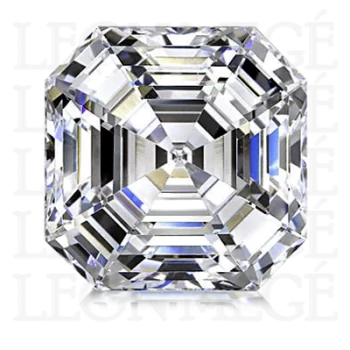
The Asscher cut is the most mysterious and stunning diamond faceting style.
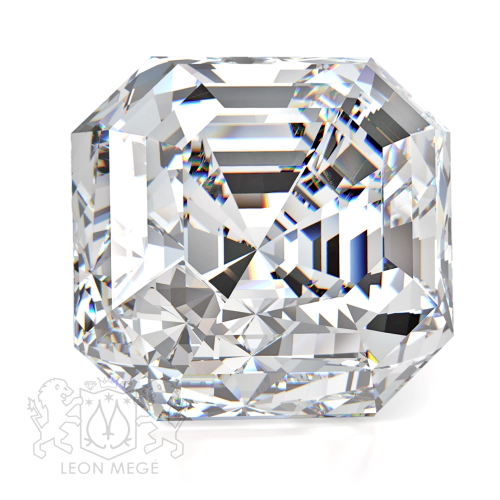
is the number of Asscher facets, however the Royal Asscher has 74 facets.
An Asscher cut diamond is designed to bring out a diamond’s clarity. This special cut highlights a diamond’s luminous presence and elegance. Its step facets radiate from a culet to the girdle in an X-shaped pattern.
All Asschers, including vintage and antique stones, are classified as cut-corner square step cuts. A well-executed Asscher rivals a brilliant cut in fire and even in brilliance.
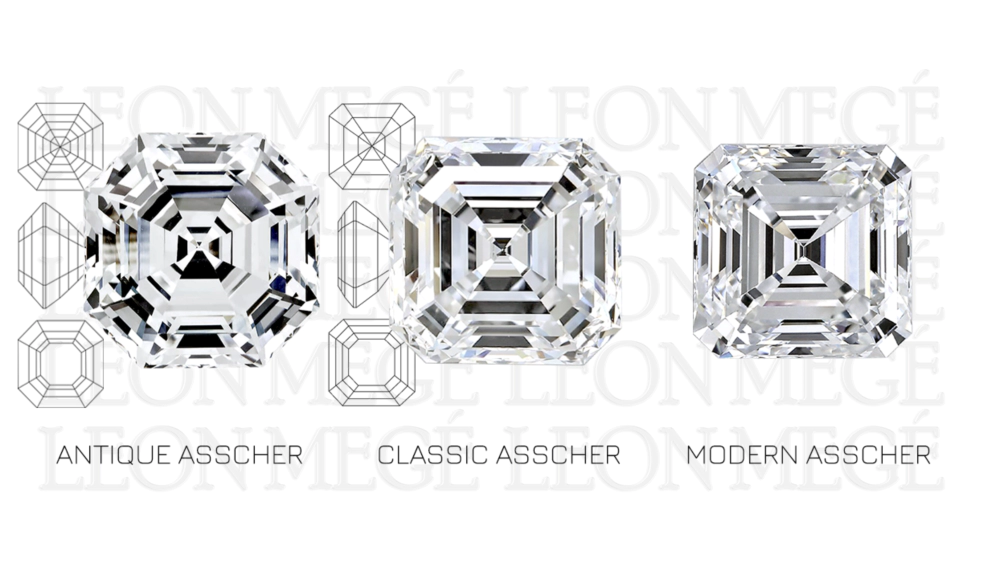
The modern “Asscher” is a trade misnomer for an emerald-cut diamond with a 1:1 ratio. It has only one common trait with a real Asscher—step-cut faceting. The modern “Asscher” lacks the charm and appeal of the classic Asscher cut.
Classic Asschers are scarce because rough yields are meager, and demand is limited because of their high cost and relatively small size-to-carat weight ratio.
Authentic antique Asschers are extremely rare and found in antique jewelry. They are almost octagonal stones with a very small table, high crown, and deep pavilion.
True Antique Asscher
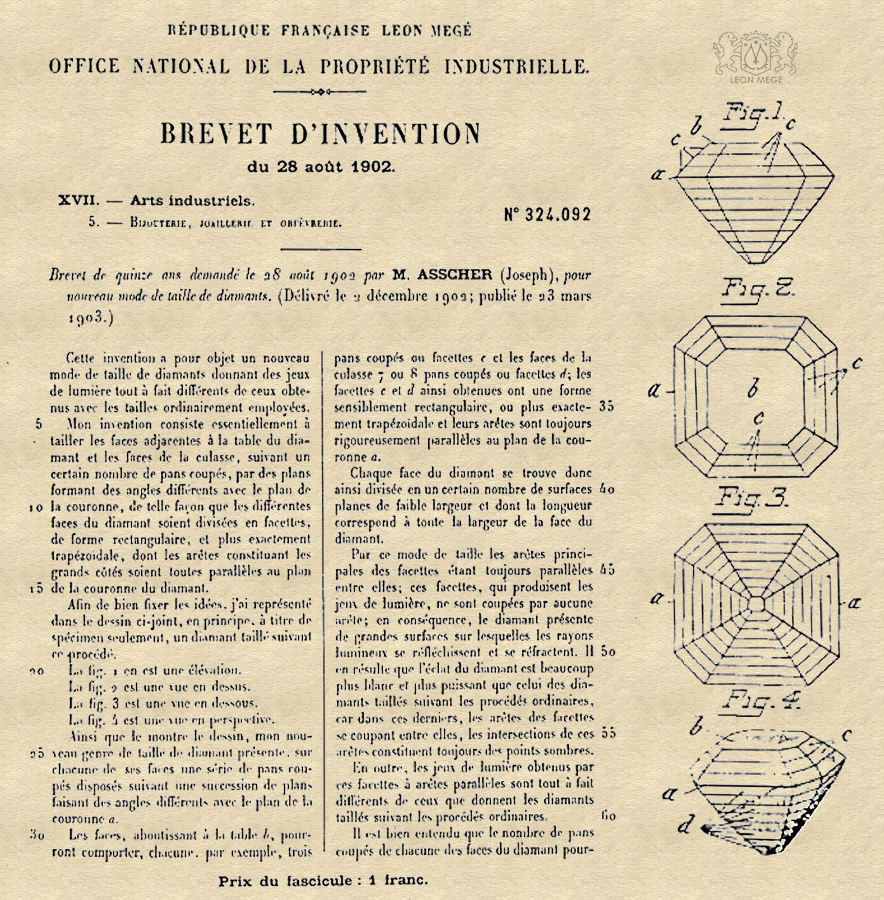
Joseph Asscher created the world’s first patented octagon-shaped step-cut diamond in 1902. An Asscher cut diamond seems to draw the eye to the center of the stone, to its magical depth, and to the source of its incredible fire.
It is an octagonal cut with corners almost as wide as the sides, a small table, a high crown, and a deep pavilion. The table of an antique Asscher is typically less than 50%, with a total depth exceeding 70%, and with evenly spaced facet steps.
Antique Asschers are hard to find and usually come from estate jewelry. True Antique Asschers are modern replicas of the antique cut. Due to their scarcity, both the antique Asschers and their replicas command premium prices.
Classic Asscher
The Classic Asscher is a contemporary take on the antique Asscher cut. It mixes the wide-corner, small-table, uniform-facet concept with the low-crown, shallow-pavilion proportions of a contemporary emerald cut.
The Classic Asscher cut produced today is not as deep as the Antique cut. Its table hovers at around 60%, its depth is between 65% to 72%, its crown is lower, and the corners are not as wide.
Classic Asschers are reasonably priced, but they are in a limited supply and require a trained eye and lots of time and patience to distinguish them from modern Asschers.
Modern Asscher
A square emerald cut diamond, often called Asscher in the trade, lacks the mysterious elegance and finesse associated with the true Asscher cut. These stones usually have tiny corners, a shallow less than 70% depth, and a large table exceeding 60%. To call this cut Asscher is, at minimum, misleading, and there is very little value in buying such a stone.
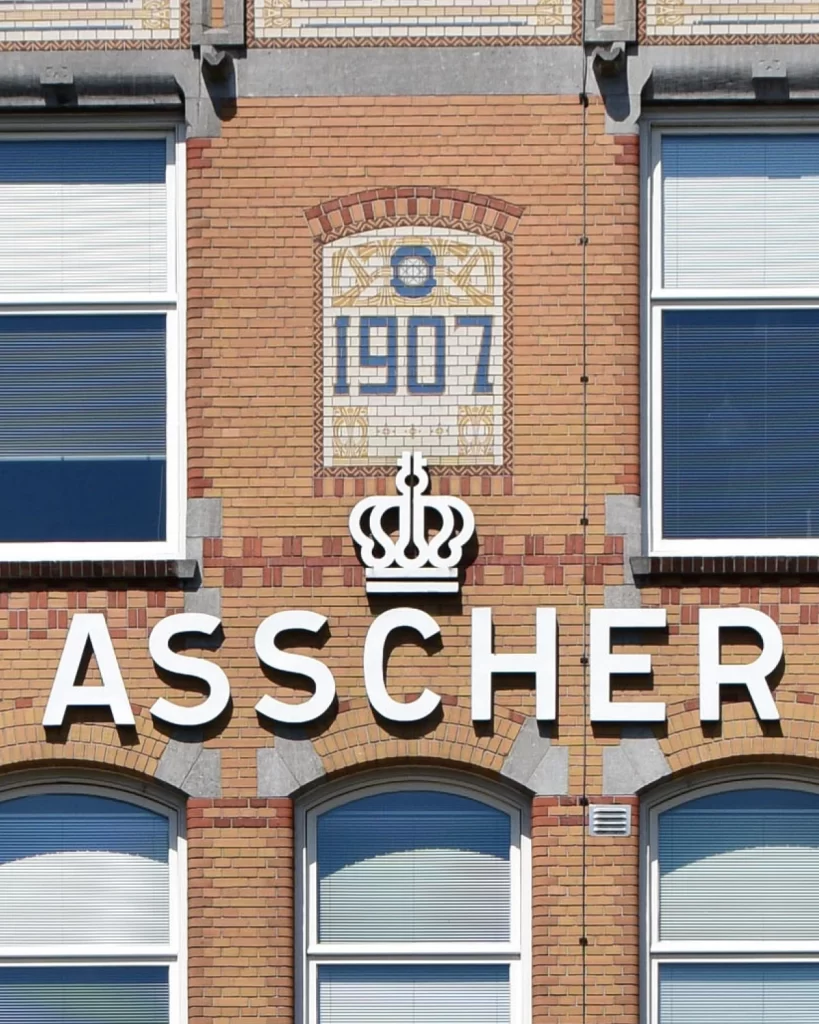
The Asscher cut was created by the diamond cutter Joseph Asscher. His Royal Asscher Diamond Company Ltd. was established in Amsterdam in 1854. The extended Asscher family is renowned for being excellent diamond cutters and polishers. They work with hard-to-cut odd-shaped rough and are known to produce beautiful gems.
The Asscher factory once employed 500 people. In the old days, polishing wheels powered by steam engines were attached to long shafts with leather belts. The driving shafts ran the entire length of the building. Even after the introduction of electricity, the original shafts were retained.
Royal Asscher® is a patented cut with two additional pavilion steps sold at a steep premium. They are laser-inscribed with the brand logo and an identification number. The Royal Asscher® brand name is printed on the certificate.
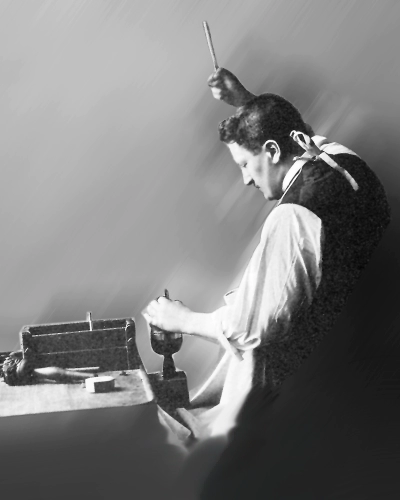
The Asscher family had been in the diamond trade in Amsterdam since 1854, when Joseph’s grandfather opened a modest little cutting workshop, the kind of place where a man could make a fortune polishing diamonds, or lose his last shirt with one careless tap of the hammer.
Two brothers, Joe and Abe Asscher, grew the business into one of Amsterdam’s most respected diamond-cutting factories, the Asscher Diamond Company, and made the brisk trade during a pre-war era when the whole world had gone mad for the oily glow of diamonds on the wrists of society ladies. In 1903, Joseph was handed the honor of cutting the Excelsior, then the largest known diamond on earth.
Joseph earned a reputation as the finest diamond cutter among Amsterdam’s diamond elite by turning a single 997-carat rough crystal into eleven polished gems. This reputation opened the door to more nerve-wracking jobs and, sure enough, in 1907, Joseph’s real moment arrived. He was hired to cut the largest diamond rough ever unearthed, the 3,106-carat Cullinan, dug up two years earlier near Pretoria, South Africa. The Transvaal government presented the stone to King Edward VII, and in 1907 the rock made its way to Amsterdam into the hands of Joseph Asscher.
The story of Cullinan
The Cullinan cleaving legend is as juicy as unbelievable. The 3,106-carat rock had to be split into three sections on account of internal flaws. Joseph studied the enormous rough piece for six months. We do not know whether he really sat for six months staring at the stone, but he billed the crown by the hour. He finally notched a groove at a carefully calculated spot in preparation for the big moment. The first attempt went about as badly as such things usually go in third-rate sitcoms. The blade snapped in two, and the diamond didn’t do so much as blink. After regrouping and tossing out the broken tool purchased at the nearby flea market, he spent a small fortune on a good Swiss-made blade and tried again.
At precisely 3:05 pm, on February 10, 1908, he took a shot of Jägermeister, mumbled something in Yiddish, hit the cleaver, and immediately passed out. After regaining consciousness, he learned the stone had split exactly as planned. Was it unbelievable stress or too much Jäger responsible for his fainting? We’ll never know. But it was a great success. Nine stones eventually came out of the various pieces. The two largest diamonds, the 530.20-carat Cullinan I and the 317.4-carat Cullinan II, are still held hostage by the British Crown Jewels; one is embedded in the Sovereign’s Scepter and the other in the Imperial State Crown.
Joseph Asscher created the world’s first patented octagon-shaped step-cut diamond in 1902. An Asscher cut diamond seems to draw the eye to the center of the stone, to its magical depth, and to the source of its incredible fire.
It is an octagonal cut with corners almost as wide as the sides, a small table, a high crown, and a deep pavilion. The table of an antique Asscher is typically less than 50%, with a total depth exceeding 70%, and with evenly spaced facet steps.
Antique Asschers are hard to find and usually come from estate jewelry. True Antique Asschers are modern replicas of the antique cut. Due to their scarcity, both the antique Asschers and their replicas command premium prices.
Selecting and buying Asscher cut diamond
- It is not true that low color will make the flaws in Asscher more visible. All antique diamond cuts tend to mask the diamond color and make it less noticeable. Warmer-colored Asschers look more natural and face up whiter than expected.
- The recommended minimum clarity for an Asscher cut is VS1 because the inclusions are easier to see in step cuts.
- The most desirable Asschers have very wide corners. They are nearly octagonal, bringing them closer to the original historical cut.
- Shallow depth benefits the larger look, but true Asschers are, by nature, deep stones.
- Real Asschers are deep, with a total depth exceeding 70%. Spreadier stones with 60%-68% depth offer a better size-to-weight ratio.
- Asscher cuts are not cut for brilliance but for fire.
- Make sure that your Asscher cut diamond has a GIA grading report. This is the world’s most respected diamond grading laboratory.