Chain vs. Necklace
A necklace is set with gemstones, while a chain is just metal. There is a grey area; for example, Elisa Peretti’s Diamonds By The Yard can be classified as a “chain” or a “necklace.”
- A choker is a short necklace resting on the collarbone
- Sautoir – very long necklace
- A Rivière is a single strand of diamonds of either equal size or graduating down in size toward the back.
- Festoon is a garland of flowers, ribbons, or leaves hung in a curve as a decorative element.
- Fringe has a series of pendant elements that dangle from links or cords
- Collier or Collar necklaces are typically 12 to 13 inches long, resting flat on the body
- A pendant is a necklace or a chain with a jewel or medallion dropped from the center
- Lavalier or Negligee is a small-link, fairly long necklace terminating in a single large pendant or tassel
- Lariat necklaces don’t have a clasp. They are either tied or pulled through an opening on the other end
- Bib or Plastron
- Opera is typically around 26 to 36 inches long
- Matinée is approximately 20 to 22 inches long
- Princess is typically 18 inches long
- The rope is over 30 inches long
Necklace length

- The Choker is 14-16″ and sits snug around the neck.
- Princess is 16-18″ long, falling to the mid-chest. Princess length is the preferred length for a pendant.
- Matinée extends to 20-22″ in length.
- Opera drapes dramatically at 24-28″.
- The Rope or Lariat extends over 30″, covering the abdomen. As a double wrap, one turn is a choker, and the other is the Opera.
Diamonds-by-the-Yard: a chain or a necklace?
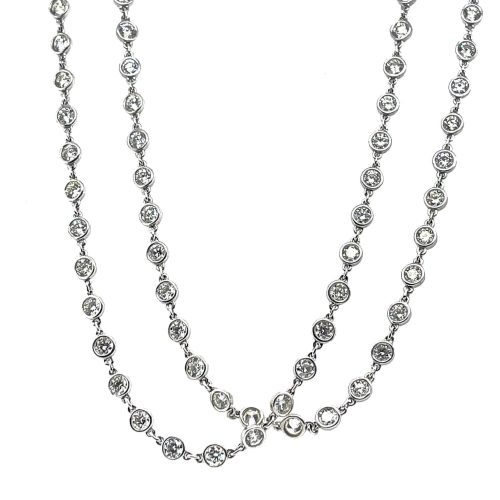 Tiffany & Co.’s “Diamonds by the Yard” is a type of “Station Chain” design in which decorative charms, such as gems, pearls, beads, or other decorative chachkas, are inserted into the chain at regular intervals. Tiffany & Co. debuted the design by Italian designer Elsa Peretti in 1974. The chain features channel-wire-wrapped diamonds spaced at regular intervals. Channel wire is a partially open hollow tube wrapped around the diamond girdle like a flotation doughnut around a fat swimmer. Diamond culets are fully exposed and become increasingly uncomfortable in larger sizes. In addition, large stones lose balance and droop. Generic “Diamonds by the Yard” chains often mitigate this problem by setting stones in a barrel-shaped bezel instead of wrapping them in channel wire. That looks completely different from Peretti’s original organic design. The idea of buying diamonds by the length, the same way you’d buy ribbon at Macy’s, resonated with consumers. The bezel-set diamonds float along the chain, light and unassuming, like a sparkling line of brisk glints. Over the following decades, the design shifted from a novelty to a “real” piece of jewelry, perfect for a graduation or anniversary gift. The design flexibility helped, since the same necklace can be worn alone, layered with other chains, or doubled around the neck.
Nowadays, “Diamonds by the Yard” has become a generic term for the station chain set with gemstone-set links, and nearly every jeweler offers some version of it. A station chain says something about restraint, about preferring a few well-placed stones to a display of them. Arguably Peretti’s fifty-year-old design still feels current.
Necklace and chain clasps and closures
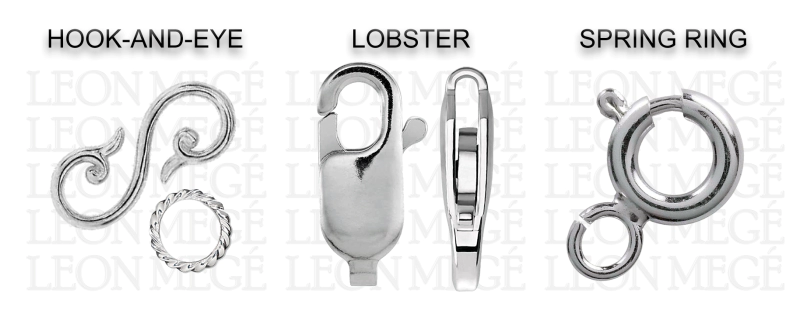
 The hook-and-eye, or S-hook, is the easiest and least secure clasp, with a hook that slips into an opening to keep the chain in place.
- The lobster clasp is the most desirable and secure carabiner-style lock, with a spring-loaded gate that snaps back into place once the cap end is inserted. It is opened by simply pulling a small lever that lifts the lip, allowing the cap end to be released.
- The spring ring is a simple, lightweight clasp made from a hollow tube with an internal spring. Pulling the lever opens the slot for a cap end to be inserted. Once the lever is released, the clasp locks the cap end.
- The alligator clasp serves as a traditional lock or a clip for accessories. It features a large loop suitable for multi-strand designs, large cords, or leather strings.
- Ball-and-Joint clasps use pressure to keep the clasps closed. Their easy-open and easy-close design is too flimsy for expensive necklaces, so they are used mainly for lightweight chains.
- The Fishhook clasp has a fishhook-shaped tongue threaded inside a box where it clicks in place. Ideal for lightweight necklaces and bracelets.