
Bending a Ring Around Another Ring: The Dumb Idea Gone Wild
An engagement ring, a traditional symbol of marriage, commitment, and enduring affection, is expected to stand on its own. It usually lets a reasonably small wedding band sit very close, with just a sliver of a gap. Yet, for its own selfish reasons, the jewelry industry has turned a misplaced desire for a perfectly flush wedding set into an aesthetic imperative.
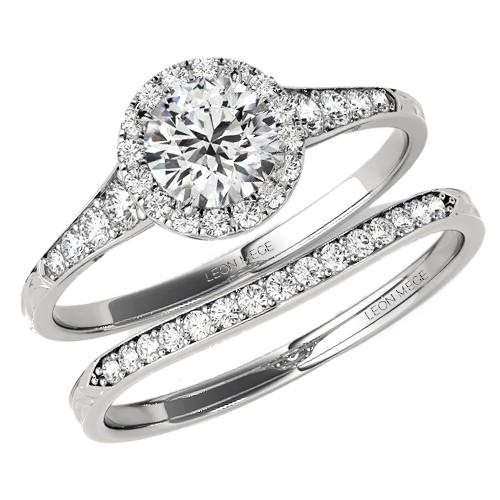
Somewhere along the way, the jewelry industry convinced millions of brides that even the tiniest space between an engagement ring and a wedding band is taboo. The proposed solution is a shadow wedding band with a deliberately curved, notched, or contoured section designed to eliminate any noticeable gap. Instead of a straightforward circle, it is bent to follow the engagement ring’s silhouette.
The same design goes by many names, including curved band, fitted band, molded band, custom-shaped band, contoured band, and wave band. The terminology varies, but the underlying idea remains the same. The wedding band is no longer an independent piece of jewelry. It has become an accessory to an accessory.
A Wedding Band With Dependency Issues
The traditional wedding band is one of the most successful jewelry designs in history. Its simplicity is precisely what makes it so compelling. A continuous circle, without beginning or end, represents the permanence of marriage. It is elegant, universal, and entirely self-sufficient.
A shadow band’s defining feature is a carefully engineered indentation or curve that nests against the engagement ring. Remove the engagement ring, and the wedding band is left with an oddly shaped, idiotic silhouette. It may resemble a shallow wave, or a ring that has suffered an unfortunate encounter with a hydraulic press. The contour that makes it work with an engagement ring is what makes it useless on its own. The craftsmanship is not in question here. A well-made shadow band can be executed with considerable technical skill. The problem is conceptual. A wedding band is meant to symbolize lifelong commitment, not serve as a specialized component in a two-piece assembly.
The 70s Atavism
The popularity of shadow bands stems directly from 1970s bridal trends. That decade was defined by massive, elongated center stones, marquises, ovals, emerald cuts, and cushions, often flanked by now-nearly-gone trillion side stones. When these towering rocks were paired with oversized eternity bands, the two rings were forced apart at an awkward, nearly 90-degree angle. The resulting gap was both aesthetically jarring and unacceptably uncomfortable – the direct result of pairing two independent rings on a single finger. One solution led to even bigger atrocity: setting diamonds unnaturally high off the finger. But that is a story for another day. In contrast, most contemporary engagement rings feature moderately sized center stones and properly angled baskets, with prongs anchored on top of the gallery rather than overlapping it, or other structural elements that let a conventional wedding band sit tight against the ring.
The aesthetically challenged executives at low-end chain stores (you know, those where every crap begins with K) jumped on the idea and rushed to fill display cases with all sorts of contoured bands. It let them market both rings as a set and double the profits.
“Full Cleveland” if You Know What I mean
 Rather than preserving the timeless, circular symmetry of a classic wedding band, shadow bands are unnecessarily warped and distorted versions, presented as a solution to a problem that no longer exists. As a result, the band is demoted to a subordinate accessory, burdened with an exaggerated, swollen curve that could make Stormy Daniels jealous. This forced arrangement might look okay as a set, but worn alone, the absolute absurdity of this “design” becomes embarrassingly clear. The wedding band, once a proud symbol of marriage, is now a barely distinguishable secondary prop.
The Symbolic Problem With Curved Wedding Bands
Jewelry design with curvy, free-flowing lines is a staple of so-called sculptural jewelry and serves a coherent artistic purpose. A shadow band, however, serves a less compelling purpose: filling space that should be left alone. Proponents argue that a curved band disappears into the engagement ring when the two are worn together. That argument does not hold water. The wedding band’s sole purpose is to symbolize marriage, not to enhance the engagement ring’s appearance. A wedding band isn’t a decorative vestige; it’s a separate piece of jewelry with its own important meaning that should not be lost to a casual observer.
Shadow Band Never Makes Sense
A wedding band should not have to apologize for being a wedding band. Two independently designed rings do not need to form a seamless unit. In fact, a small separation preserves each piece’s individuality and lets the engagement ring retain its original proportions. Insisting on a flush fit can lead to increasingly elaborate, inferior solutions to a problem that may not need solving in the first place. Nothing is inherently wrong with choosing a shadow band, other than poor taste and a stubborn refusal to use common sense. A wedding band has its own identity, own proportions, and own aesthetic integrity. A curved band always looks awkward, with or without the engagement ring.
The Illusion of Friction Prevention
A shadow wedding band is often promoted as a way to prevent mechanical wear between an engagement ring and a wedding band. The claim is misleading.
A contoured profile may alter the contact geometry and reduce relative movement under certain conditions. It does not, however, eliminate contact or guarantee no sliding friction. Unless the rings are mechanically secured, they remain independent components that can move against one another.
Wear depends on contact pressure, relative motion, surface hardness, and the materials involved. The bands’ curvature, fit, and the wearer’s habits all influence the resulting abrasion. A shadow band may redistribute contact; it cannot eliminate friction or guarantee protection against wear.