
Appraisal Types
 Different types of jewelry appraisals serve different purposes and provide different information.
- An In-House Appraisal is usually issued by the seller and reflects their subjective opinion of overall value.
- A Replacement Value Appraisal estimates how much it would cost to replace the jewelry outright.
- A Fair Market Value Appraisal estimates what the piece could realistically sell for on the current market.
- A Liquidation Appraisal comes in significantly lower than fair market value, since it’s typically driven by the need for a quick sale, such as in cases of divorce or death.
In-House Appraisals for Insurance Purposes
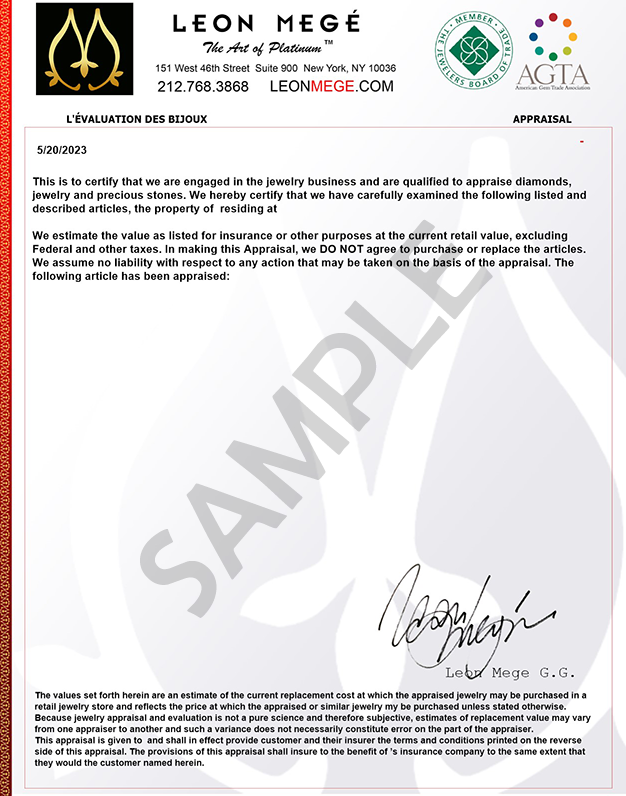 Upon request, Leon Mege Inc. will provide a complimentary in-house appraisal after completing custom work by Leon Mege or when an in-stock item is purchased. If a project incorporates client-supplied gemstones, we will require copies of laboratory reports, certificates, purchase invoices, and other documentation before preparing an appraisal.
In many cases, an appraisal is not required; insurance companies will accept a sales invoice, laboratory grading report, and other supporting documentation to establish coverage.
If your insurer requires an appraisal, Leon Mege Inc. can provide an in-house appraisal that includes a detailed description of the item together with an opinion of its current insurance replacement value. The purpose of the appraisal is to assist in obtaining insurance coverage and establishing an appropriate insured value. While we can work with a 10% valuation range to assess your piece, an inflated valuation may result in unnecessarily high insurance premiums, while an undervalued appraisal may leave the item inadequately insured.
Insurance companies determine coverage, claim eligibility, and settlement amounts according to the terms of the applicable policy. For recently purchased jewelry, some insurers may consider the original purchase price and sales invoice when evaluating a claim. An in-house appraisal is not a guarantee of future replacement cost, market value, resale value, claim settlement amount, or any other monetary value. It is an opinion of insurance replacement value as of the date of the appraisal and is intended solely to assist the customer in obtaining insurance coverage and understanding the approximate cost of replacing the item under then-current market conditions.
Independent appraisals

An independent appraisal may be appropriate when you need an objective opinion of value for legal, tax, estate, insurance, or financial purposes. Unlike a jeweler’s in-house appraisal prepared for insurance purposes, an independent appraisal is performed by a qualified third-party appraiser who is not involved in the transaction.
A professional appraiser should fully disclose their qualifications, appraisal methodology, fees, and any potential conflicts of interest before accepting an assignment. When selecting an appraiser, customers should verify the appraiser’s credentials, professional memberships, and standing with the relevant accrediting organization. Organizations such as the American Society of Appraisers (ASA) and other recognized appraisal associations may help consumers locate qualified professionals and verify credentials. Independent appraisals may be useful for a variety of purposes, including:
- Determining fair market value for estate administration and probate matters;
- Evaluating assets for equitable distribution in divorce or other legal proceedings;
- Establishing cash value or liquidation value;
- Assessing charitable contributions for tax-reporting purposes;
- Documenting loss or damage for insurance claims;
- Evaluating inherited jewelry and gemstones;
- Obtaining an independent opinion of value for personal financial planning; and
- Resolving ownership, valuation, or asset-distribution disputes.
Leon Mege Inc. does not provide legal, tax, accounting, or estate-planning advice and is not affiliated with any independent appraiser, appraisal organization, or appraisal association. Customers are solely responsible for selecting and retaining any independent appraiser and for determining whether an independent appraisal is appropriate for their particular circumstances.

Not all appraisal organizations maintain the same standards. Some associations grant appraiser credentials primarily based on membership and dues, while others require extensive education, demonstrated competency, and ongoing recertification to ensure members stay current with evolving market conditions, grading standards, and gemstone treatments.
We recognize the American Society of Appraisers (ASA) as a respected independent organization with rigorous membership requirements and professional standards. Clients seeking an independent appraisal may visit the ASA’s appraiser directory to locate a qualified professional.
Please note that we are not affiliated with, endorsed by, or compensated by the American Society of Appraisers (ASA), nor are we responsible for any services provided by independent appraisers listed in its directory.
A qualified ASA appraiser will typically:
- Conduct thorough market research to determine the appropriate value for the intended purpose of the appraisal.
- Explain the function, scope, and intended use of the appraisal report.
- Maintain strict client confidentiality.
- Retain appraisal records in accordance with professional standards.
- Complete the assignment within a reasonable timeframe.
- Provide an independent, objective opinion free from conflicts of interest.
- Disclose any assumptions, limiting conditions, or factors that may affect the valuation.
An independent appraisal should provide a clear, unbiased assessment of the item and its value, giving the client confidence that the conclusions are based on professional judgment rather than a sales relationship.