How to Excel at Somebody Else's Profession
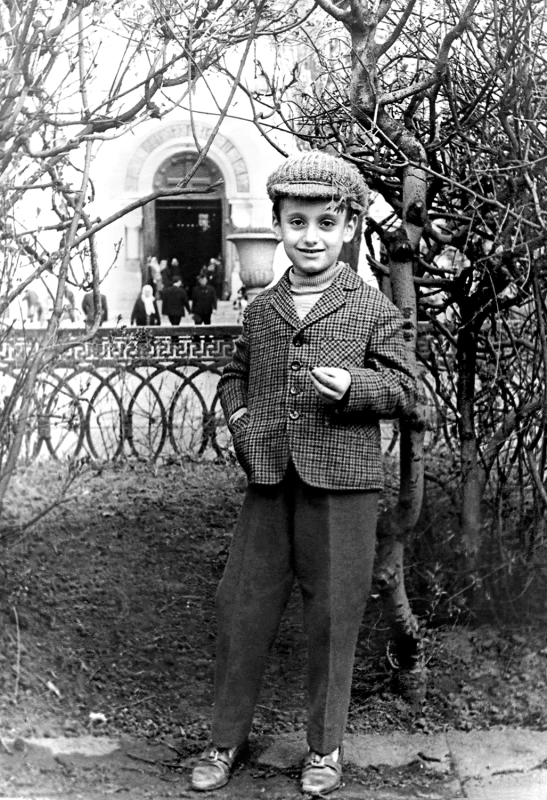
Leon Mege was born on July 4th, 1963, into a low-middle-class family of scientists in the former imperial city of Leningrad (now Saint Petersburg, Russia), whose grand architectural legacy and storied artistic heritage would quietly shape the sensibilities of the young boy who would one day become a celebrated artist and jeweler.
Saint Petersburg was not merely a backdrop to Leon’s early life; it was a living museum in a constant state of disrepair. The city’s ornate palaces, gilded cathedrals, and centuries-old traditions of jewelry-making surrounded him from his earliest days. Whether he knew it then or not, the seeds of an extraordinary aesthetic were being planted in the cobblestoned streets and frozen canals of one of Europe’s most beautiful cities.
From 1791 to 1917, the Pale of Settlement confined Jewish residency to a defined band of south and western provinces of the Russian Empire, forbidding Jews from settling in the Russian interior. Beginning in 1865, the imperial regime extended a rare privilege to Jewish master craftsmen, permitting them to live and work beyond the Pale. For example, Avram Dobricin was a jeweler who made a bracelet for the wife of Tsar Alexander II. In exchange, he was permitted to live outside the Pale of Settlement.
Leon’s great-grandfather, a talented watchmaker, seized that opportunity and resettled in St. Petersburg. Some of his tools have been passed down through the generations and remain part of Leon Mege’s personal collection to this day.
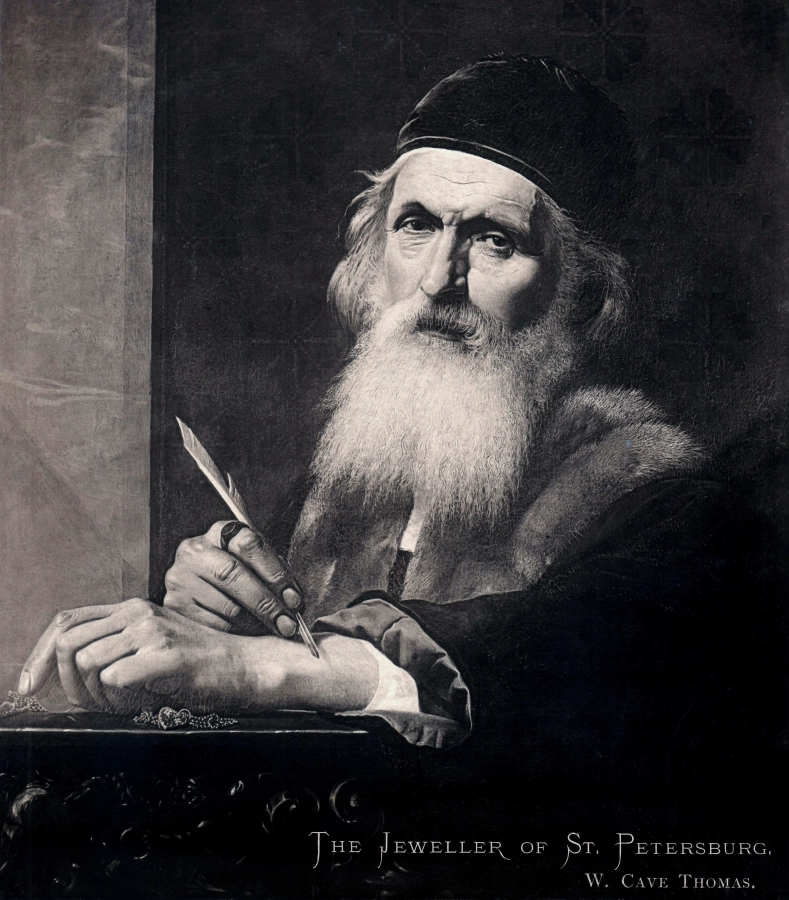
Leon came from a family of formidable intellect. His father, a trained engineer of considerable talent, had turned his sharp and restless mind toward a far more dangerous pursuit – dissent. In a Soviet Union where a careless word could mean years of imprisonment, Leon’s father wielded political jokes as a potent weapon against the absurdities of communist rule. It was an act of courage dressed in humor, and it left an indelible mark on Leon – an understanding that tiny clues carry a lot of meaning, wit, and a willingness to challenge convention were not merely admirable traits, but necessary ones.
No less remarkable, Leon’s mother was a nuclear scientist employed at a nuclear weapons research center, in a world of exacting standards, relentless precision, and zero tolerance for error. Together, Leon’s parents embodied a rare duality: the fearless creative spirit and the disciplined scientific mind. It was perhaps inevitable that their son would carry both within him.
Leon himself is quick to note, with characteristic dry humor, that he took his family’s distinguished lineage of scientists and engineers and redirected it entirely by channeling generations of ancestral expertise into what he cheerfully calls “a frivolous field of useless adornments and shiny pebbles.” The joke, of course, belies the profound seriousness with which he approaches his craft. For Leon Mege, jewelry is anything but frivolous. It is architecture at the smallest possible scale. It is an engineering rendered in platinum and diamonds. It is science transformed into something eternal.
From these unlikely beginnings – a dissident’s son in a crumbling empire, raised between political courage and scientific rigor – would emerge one of the most celebrated jewelry artists of his generation.
Early Years and Shocking Discovery
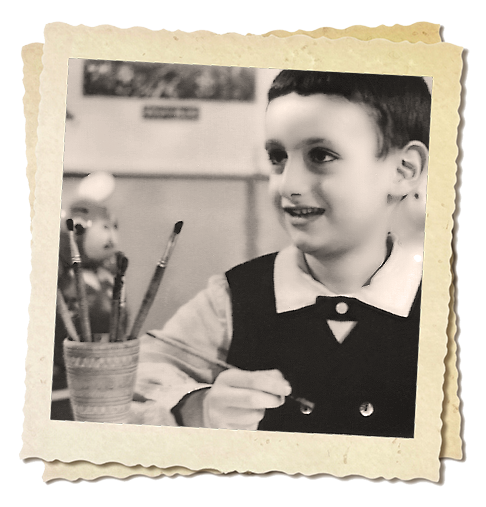
Leon’s mother proved to be an extraordinary guide in his early life. A scientist by profession, she recognized in her son a receptive and imaginative mind, ready to be introduced to the world of art. She enrolled him in a painter’s class, where he came to understand that art is not mere decoration, but a profound form of human expression, no less powerful than music or mathematics. Through art, he learned, generations have conveyed their deepest emotions: love, faith, grief, and joy.
Leon’s parents made a calculated and painful choice by hiding their Jewish identity, concealing it from their own son to shield him from the peers’ cruelty and institutionalized antisemitism that pervaded Soviet life.
In a country where being Jewish could mean closed doors, public humiliation, and far worse, silence was survival. And so Leon grew up as any other Russian schoolboy of his era, absorbing the prejudices of his environment without question, knowing nothing of the heritage flowing through his own veins.
At the age of ten, Leon learned what his parents had long kept from him. He was, in fact, Jewish. The news struck like a thunderbolt. There were only a handful of Jewish kids in his school, most of them equally in the dark about their Jewish identity or quietly instructed by their families to conceal it to avoid being a target.
In a single moment, the world rearranged itself. It turned out that he was one of those despised few, an outsider and prey for bullies.
It was a profound and disorienting discovery, the kind that can leave a permanent watermark on a kid’s soul. Yet for Leon, the revelation did not curdle into bitterness but inspired a burning desire to learn about his roots. Leon’s secular parents, fearing for his safety, were unable and unwilling to educate him on being Jewish in Soviet Russia. Jewish heritage was less a living tradition than a suppressed memory, something whispered about but never taught or practiced. And so Leon did what any determined ten-year-old with unanswered questions would do. He went to the school library. What he found there was not what he was looking for. There were no books on Jewish history, no accounts of Jewish culture and achievements. Instead, the library offered an abundance of virulently anti-Zionist literature, thick with antisemitic tropes so extravagant and so unhinged that they would have made Hitler jealous.
Leon read them anyway. Rather than feeling crushed by the grotesque caricatures of evil Jews pulling strings of every government, his spirits were unexpectedly lifted.
Because if the Soviet state’s propaganda was to be believed, his newly discovered tribe was, by any measure, extraordinarily accomplished and powerful, controlling the world’s finances and running Hollywood. Not too shabby, Leon thought, for a people his classmates had been taught to look down upon.
It was a lesson in reading between the lines and finding, in its own absurd and mysterious way, unexpected pride in the most unlikely of places. It was also the beginning of a lifelong habit of striving for absolute excellence and a lifelong instinct to look beyond the surface.
The Unplanned Career Choice - Dreams and Detours
Leon had absolutely no interest in becoming a jeweler. He was ready to devote his life to being an architect, or even higher – a city planner, meaningful work, the kind that leaves a mark on the world, the sort of career that an ambitious young man with a clear social conscience could take pride in. By contrast, the idea of crafting objects whose primary purpose was adornment felt trivial to him, even morally ambiguous. Jewelry, in his view, seemed far removed from the kind of purposeful contribution to society he desired to make.
In 1979, Leon Mege’s family made their first attempt to leave the oppressive confines of the Soviet system in search of a new life in the United States.
However, their application to emigrate was denied because Leon’s mother’s previous employment at the nuclear lab. After a long year of waiting, the authorities ultimately refused to grant them exit visas, effectively barring the family from leaving. They became “refusniks,” just like thousands of others who were held hostage by the Communist regime trapped behind the Iron Curtain, and unable to escape.
Then, in 1979, Soviet forces invaded Afghanistan, and whatever slim hope remained of a thaw in the political climate evaporated almost overnight. Emigration became not merely difficult but effectively impossible. Leon’s dream of attending college gradually slipped out of reach. For a young man from a family marked by political suspicion, higher education was effectively closed off. Being a potential target of political repression, the inevitable consequence of showing disloyalty to the regime left them vulnerable to repression and shut the doors to educational institutions.

In that climate, defined by intolerance toward dissent and a rising undercurrent of antisemitism, Leon turned to a more practical path. He enrolled in a trade school to study jewelry making, a choice that both suited his artistic abilities and offered a critical advantage: a two-year deferment from compulsory military service.
For his family, those two years represented a sliver of time when they believed the authorities might reconsider their case and grant the long-awaited permission to leave the country. In 1981, Leon graduated from State Art College #11 (Художественно-профессиональный лицей Санкт-Петербурга имени Карла Фаберже) and went to work at the only jewelry factory in the city of 5 million.
The Making of an Artist

Draft postponement did not help, and in the fall of 1982, Leon was drafted into the Soviet military. This was not the future he had envisioned, but very little about Leon’s life had been ordinary. The military exposed him to a world of rigid hierarchy, relentless routine, and suffocating conformity, precisely the kind of environment least suited to a young man with an artist’s eye and a dissident’s spirit.
Leon served two years of mandatory conscription in the Soviet Army between 1982 and 1984, amid the grinding carnage of the Soviet-Afghan War. Sustained by his sense of humor and his junzi philosophical convictions, he managed to persevere through two years in an atmosphere of Kafka-esque idiocy, strict discipline, malnourishment, and hazing while living in sub-standard conditions.
After his discharge, Leon resumed work at the same workshop where he had begun his apprenticeship before being drafted. It was the only place that could not legally refuse his employment.
Advancing his jewelry-making skills was Leon’s top priority; the craft he was quietly, steadily mastering. During this period, he formed a close friendship with an older craftsman who, in his youth, had trained under a former Fabergé jeweler. He became Leon’s mentor, sharing his intimate knowledge of traditional metalworking.
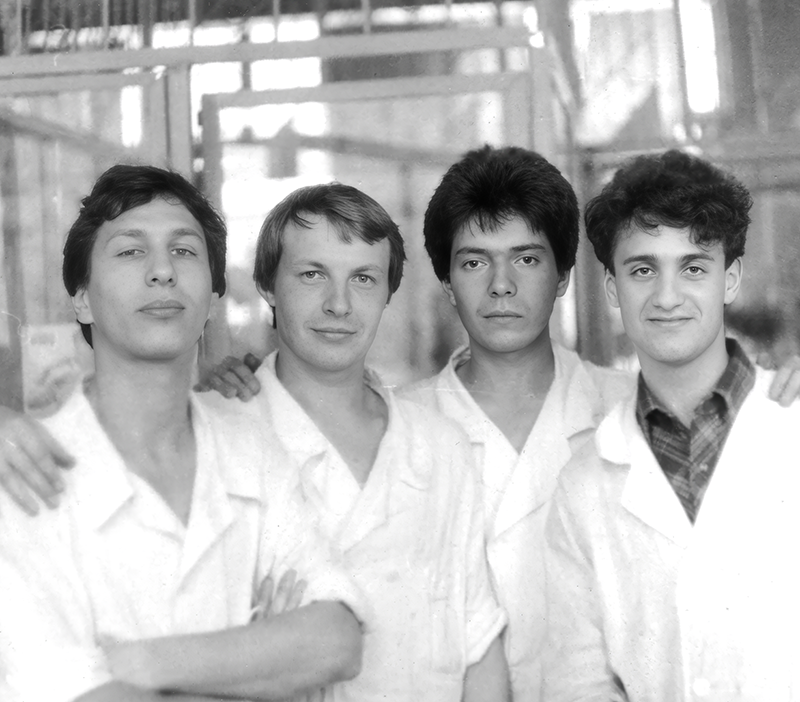
The deplorable working conditions at the factory were best depicted in his novel “Grandmother” by the renowned Russian writer Max Bitter:
“Every morning, they came in droves: men and women worn thin, heads lowered, faces sallow from nights of hard drinking, their clothes stiff with old grime. Like frightened roaches, they hastened out of the bursting-at-the-seams old city buses towards the gaping void of the factory’s security checkpoint. One by one, they disappeared inside, swallowed by the dim entrance where they worked their fingers to the bone all day, breathing vile air with acid fumes burning their throats. They typically made uninspired, mediocre pieces approved by the state, which they could not afford to purchase for themselves on their meager salaries, which were barely enough to feed their families. By evening, they emerged again, spent and hollow, cast out into the cold as the sun bled red shadows across the snow-covered roofs.”
In a world where conformity is the safest posture and complacency the wisest strategy, Leon Mege has always had an inconvenient habit of speaking exactly what is on his mind, regardless of how inconvenient the truth may be. He displayed remarkable courage in advocating for workers’ rights, even when such actions carried significant risks. He was, in the eyes of the Soviet surveillance state, a rebel, a person of interest who was permanently on the radar of factory management and local authorities. The tension was always there, coiled beneath the surface of his daily working life, waiting for the right moment to snap.
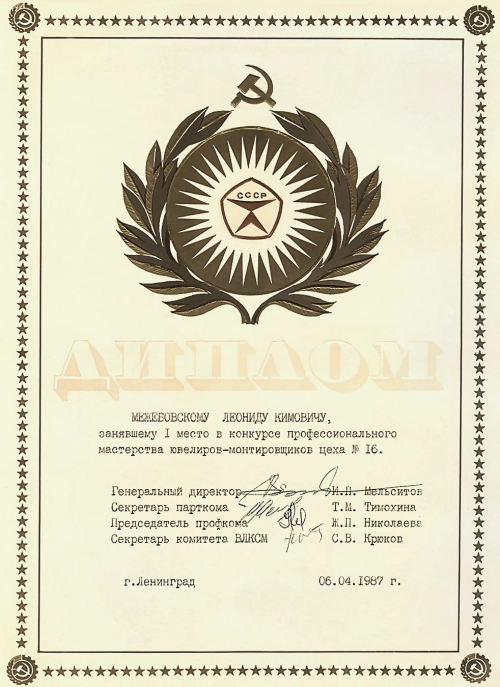
In 1987, as the first currents of political reforms began to stir and the word “perestroika” echoed through everyday life, the factory administration announced a design competition. to allow jewelers to showcase their skills and compete for promotion. For the jewelers, it was a rare opportunity to be seen as individuals rather than interchangeable components of the production line. All entries were submitted anonymously in a new “democratic” format that shielded participants from corruption or discrimination. The result backfired. Leon Mege’s ring design won the top prize, impossible to ignore by the factory administration, equally impossible to forgive. Instead of receiving a promotion, Leon was fired on the spot. It was, objectively speaking, an outrage.
The American Dream

The new political reforms of Mikhail Gorbachev in the late 1980s opened the door for thousands who had been waiting for decades for exit visas. For Leon, like many others arriving in New York from the Soviet Union in 1988, it was a dramatic shift, defined by sensory overload, immense cultural contrasts, and a respite from shortages of basic goods.
Leon’s family settled in bustling New York City and found their first home in Brooklyn. Leon Mege arrived in New York in 1988 and was lucky to join the team of the prominent American designer Henry Dunay as a bench jeweler. Those years with Dunay were truly transformative for Leon, profoundly influencing his artistic philosophy in jewelry.
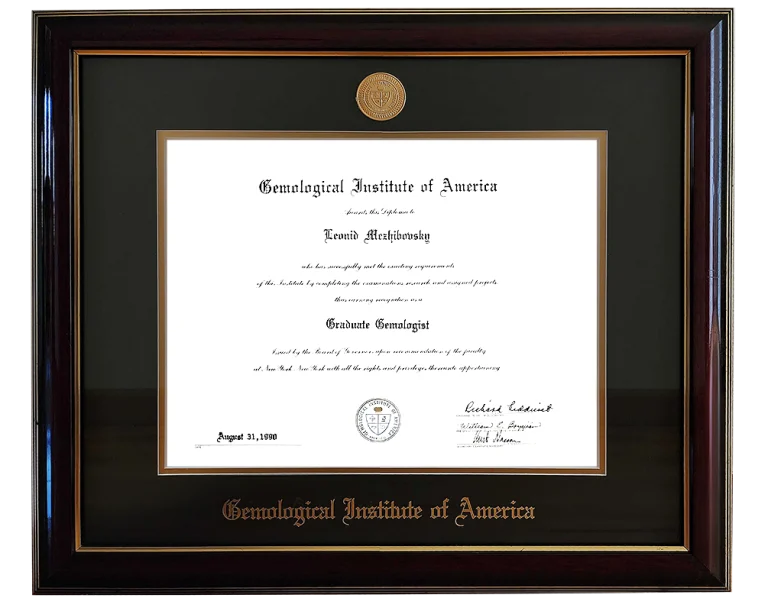
While still working as a jeweler at Henry Duney, Leon enrolled in the evening diamond grading courses at the Gemological Institute of America. Eventually, he decided to leave his job to attend GIA classes full-time. His dedication paid off when he earned the Graduate Gemologist diploma, a credential that marked a significant turning point in his professional development.
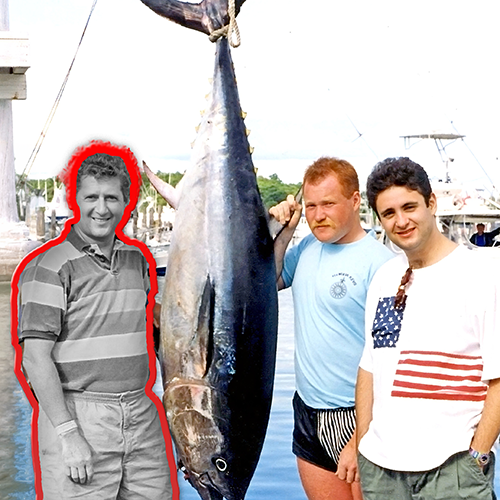
But no life driven by genuine ambition is free of setbacks. After graduation, Leon hoped to pursue a career as a gemologist, but the recession of the early 1990s forced him to return to the bench. Leon landed an exciting position with the infamous New York jeweler Werner Lippe, a highly skilled yet complex figure in the industry. Known for his incredible craftsmanship, Lippe created important pieces for notable clients such as Donald Trump and Yoko Ono, making this an excellent opportunity for growth and experience.
Years after Leon left the company, Lippe’s life took a dark turn. In 2008, Werner was convicted of murdering his wife. He died in prison in 2026 while serving a 25-to-life sentence. This horrific event was somewhat predictable, given Werner’s psychotic personality.
The Name Change: Leon Mege Brand is Born
After serving his time with Werner Lippe, Leon Mege set out on his own. In 1996, at the age of 33, he founded his own company, which was incorporated in New York in 2005. He quickly began taking on work from some of the most respected names in the trade, including William Goldberg, Siegelson, Stephen Russell, Raymond C. Yard, Van Cleef & Arpels, Bayco, De Young, T. Gluck, Martin Katz, and Harry Winston, among others.
At the same time, recognizing that his surname, Mezhibovsky, was too long and too ethnic for both ring inscriptions and building a recognizable identity, he adopted the name Leon Mege. It was conceived as a subtle play on the sound and grace associated with the Fabergé name, marking the beginning of a distinct, independent jewelry brand.
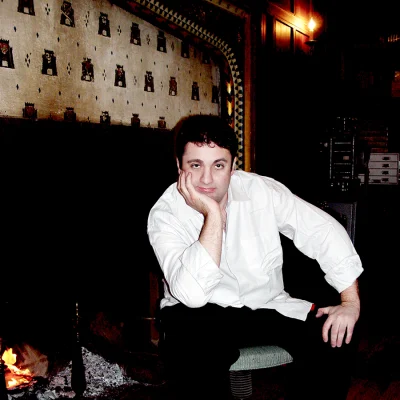
The Path to Success
In 1996, Leon Mege opened his Madison Avenue workshop, marking a pivotal new chapter in his career. At the time, he worked primarily as a contractor, collaborating with gem dealers who supplied major jewelry houses. This arrangement offered certain advantages but also posed notable challenges. Working through intermediaries often meant limited control over intellectual property, rushed and, sometimes, unrealistic production timelines, pricing constraints, and little room for contingency planning.
Perhaps the greatest challenge, however, was the communication gap. Working through a middleman often meant that the client’s precise vision was not fully conveyed. Quite surprisingly, retailers often lacked a complete understanding of how fine jewelry is made, its technical and mechanical demands, and aesthetic nuances. It was difficult to translate a client’s expectations into a truly refined final piece.
In due course, Leon Mege took up residence in a rather splendid penthouse atelier – a grand affair occupying the prestigious corner of Fifth Avenue and 47th Street in Manhattan. Propelled by an absolute commitment to excellence and a relentless attention to the finer wishes of his clientele, he decided to open his doors to all visitors, whether they belong to the jewelry trade or possess the good taste to seek top craftsmanship directly. This approach removed the bumbling middlemen from the transaction, affording Leon Mege the pleasure of collaborating personally with each client, resulting in jewelry defined by superior craftsmanship, considered design, and the sort of enduring value that one doesn’t just stumble upon.
His team came to include highly skilled, European-trained platinumsmiths and stone setters, craftspeople drawn by the opportunity to work with a designer committed to creating nothing less than exceptional pieces. The workshop became a place where precision, artistry, and ambition converged.
Handcrafted Jewelry Rooted in European Tradition
Today, operating under the iconic slogan The Art of Platinum™, Maison Megé is one of New York City’s most celebrated bespoke jewelry ateliers, renowned for handcrafted platinum engagement rings, custom bridal jewelry, and one-of-a-kind, rare gemstone pieces. Leon Megé Inc. has grown into a globally recognized name in custom fine jewelry design.
Leon Megé is internationally recognized for his outstanding craftsmanship, deeply rooted in European tradition, and his pioneering work with micro pavé. Holding several design patents in jewelry and diamond cutting, Megé built his reputation on superb professionalism and crystal clear ethics. His pieces are produced in his New York City workshop using the finest diamonds and gemstones, reflecting decades of artisanal expertise.
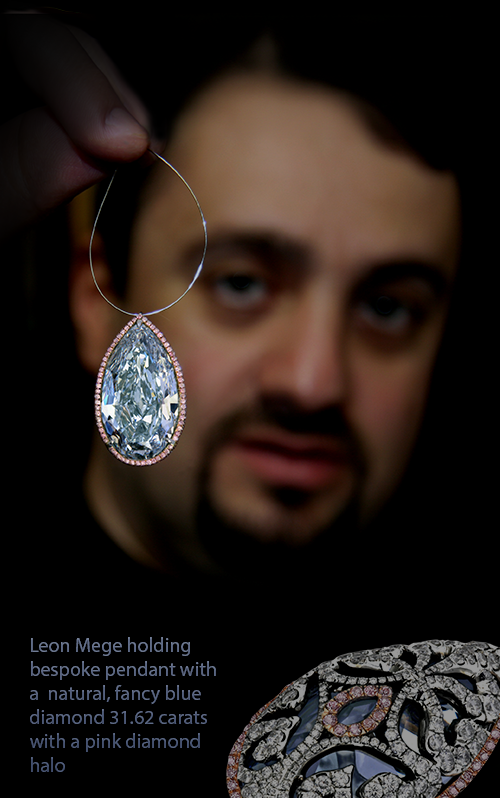
In 2014, the atelier relocated to a new space in the heart of New York’s Diamond District, close to Times Square and the International Gem Tower, which houses the Gemological Institute of America. Here, his creations come to life, precise, luminous, and subtly defiant. They challenge convention while respecting tradition, embodying a kind of beauty that is not merely spectacular but enduring, one that is passed down through generations.