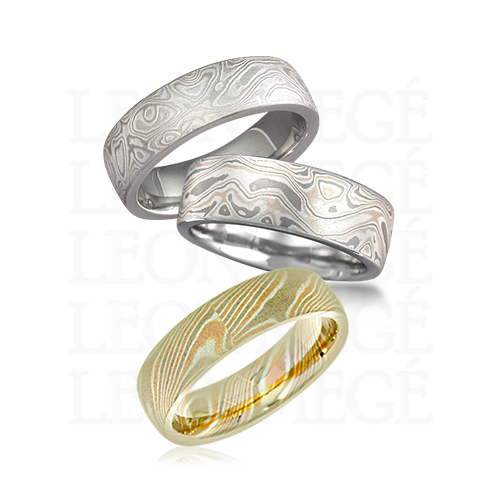
The exterior surface of a jewelry piece can be textured, engraved, or paved with small gemstones, typically diamonds. These finishes are applied only to the outside; the interior remains polished. The contrast highlights the design and ensures the textured finish appears intentional and refined, rather than a sign of poor craftsmanship.
No matter what finish you choose for your ring at first, over time it will become hard to recognize as pits and scratches build up, showing its age and character.
Unlike gold, which, with time, turns dull and unattractive, platinum develops a dignified, noble patina as it ages. Vintage platinum aquires a unique look that can’t be mechanically reproduced. It is often described as a beautifully distressed “shabby chic”, similar to softly shimmering rustic silverware, thanks to tiny, microscopic dings and pits.
Here’s an exhaustively long list of metal finishes:
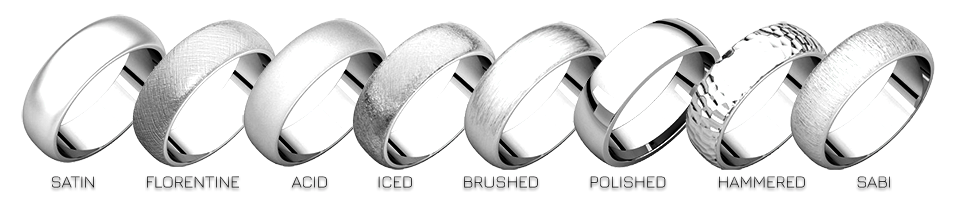
High gloss finish is a bright, mirror-like surface with clear, high-contrast reflections and no visible haze.
The ultra-refined polishing technique, especially prized in precision-forged jewelry where uniform curvature and edge definition are critical, produces a deep, liquid-like luster. At certain angles, the surface reflects light so uniformly that it appears jet-black, while at other angles it reveals a sharp, mirror-like sheen.
“Kruger’s Guide to Industrial Smoothing” states that a high degree of polish requires precision at the 1–2-micron level, which depends on the metal’s density and hardness. For example, it’s impossible to achieve high gloss on softer or porous metals, such as 22-karat gold or pure platinum.
Bright polish remains the most popular choice among men and women. 99.5% of women and 92% of men choose a bright polish for their wedding bands.
Also known as black polishing, Zaratsu is reserved for flat surfaces of hard metals such as stainless steel. By pressing the metal against a spinning tin wheel with increasingly fine abrasives, the surface is polished to a flawless, distortion-free mirror finish. A technique most often found in the world of fine watchmaking.
Matte is a dull polishing left unfinished. It represents an early stage in the journey toward a high-luster finish, where the surface remains subdued and hazy rather than reflective.
Exceptionally fine and smooth, the Satin finish imitates the soft sheen of silk. Its countless microscopic lines, invisible to the naked eye, diffuse light into a hazy glow. The satin finish is achieved by gently scorching a polished surface with fine steel wool.
An Iced finish, an irregular faceted, alive with scattered light finish, with a lively, crystalline effect. Its surface evokes the ice rink after Team USA beat Canada in overtime, minus bloody stains and a few broken teeth.
Defined by deliberate, one-directional strokes, the Brushed finish is composed of fine, uniform lines. These are applied either by hand or with a rotary tool. The coarseness of the texture depends on the grit, giving the finish a range from subtle to pronounced.
A Stone or Bark finish features a rough, dented surface with a random, granular texture, often formed during casting and left partially unpolished. The effect emphasizes the metal’s raw character, evoking a naturally rugged surface. Its irregularity adds a tactile, organic quality that contrasts sharply with more refined finishes. It is never used in fine jewelry except for a few rare sculptured pieces by jewelry artists.
Derived from the Japanese word for “beautiful,” the Sabi finish is applied by making shallow parallel grooves with a knife-edge burr. The technique results in a bold, tactile surface with contrasting sheen. The finish popularized by the legendary jewelry designer Henry Dunay can help authenticate his pieces.
Florentine finish, depending on the etching depth, resembles fine fabric or coarse textiles. Often produced with a special graver cutting multiple parallel lines in a single stroke, it has been a hallmark of the Buccellati luxury house. While its popularity waned after the 1980s, the finish remains a testament to high artistry and meticulous craftsmanship.
The Hammered finish has a rough, crudely forged appearance, with small dents covering the surface. In modern production, these dents are typically machined with rotary tools. In the past, the surface was hammered by hand, producing an uneven yet lively pattern.
The Acid finish, also poetically called the Frost finish, is achieved by applying chemicals that dissolve thousands of microscopic pits across the surface. This method efficiently creates a sparkling, textured look, often used in industrial-scale jewelry finishing.
The Sand or “Sandblasted” finish is achieved by propelling fine glass or aluminum oxide particles against the metal surface at high speed. The result is a uniform, medium to coarse matte appearance that subtly diffuses light with a silvery shimmer. The finish emphasizes form over shine, lending a contemporary, tactile quality to the piece while highlighting shapes and profiles.
The Corrugated finish is a series of repeating ridges and grooves gouged across the metal surface. The repeating pattern can be subtle or pronounced, depending on depth and spacing. It can be achieved by casting, hammering, milling, or using rotary bits. The rugged Retro-Futuristic finish is an instant TikTok crowd-pleaser.
Inspired by Etruscan and Renaissance styles, Granulation evokes historical artistry and a sense of refinement. It is an ancient technique of using intricate patterns of tiny metal spheres fused to the surface. Rather than traditional soldering, the granules are attached through so-called colloidal fusion: copper salts in a mix of organic compounds are heated, bonding the granules seamlessly without melting the underlying metal. The technique was famously revived in the 19th century by jeweler Fortunato Pio Castellani and continues to be employed by luxury houses today.
The Honeycomb finish features a hexagonal relief pattern on the metal surface applied through engraving, casting, or piercing. The repeating hexagon motif is inspired by nature. This finish feels both contemporary and architectural, with a cage-like aesthetic.
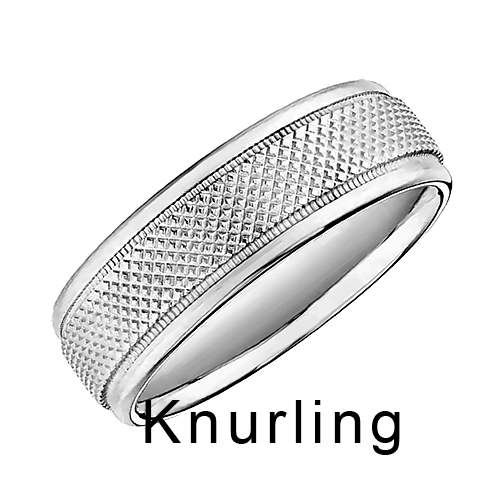 Knurling is a machining process that creates a precise, diamond-shaped crosshatch pattern on metal. Traditionally used in tools to improve grip, it produces a crisp, tactile surface defined by intersecting lines.
In jewelry, knurling is employed as a decorative finish, introducing a subtle industrial edge and refined texture. It is sometimes mistaken for milgraining, though the two differ in both technique and visual character.
Knurling is angular, defined by intersecting lines, while milgraining is rounded and continuous, defined by a row of fine beads.
The Distressed finish is an intentionally aged surface, created by a forced abrasion or scorching the metal to produce a time-worn appearance.
Though artificially induced, it echoes the natural evolution of metal, developing character through wear, contact, and time. The result is a surface that feels lived-in and individual, with a quiet patina that tells a story from the very beginning.
Milgrain
Milgrain is a special technique of finishing sharp edges created during stone setting in bezels or bright-cut pave. Milgrain can also be used on its own as a decorative border framing. In this capacity, it is often used along the sides of a traditional domed wedding band. Beyond its decorative role, milgrain subtly conceals minor irregularities and enhances the overall composition with texture and flair.
Milgrain is created by imprinting rows of tiny beads along the edge, softening sharp edges while introducing a refined, lace-like border. The technique is straightforward; a specialized tool is rolled along the edge. In tighter areas, a hand graver and beading tool are used to form each bead one by one. Milgraining is usually done by a setter or engraver (a person, not a tool) and requires control, consistency, and a trained hand.
Mass-produced milgrain is created through metal casting, which lacks the sharpness and vibrancy of genuine milgrain that is applied by hand. While casting may appear lacy from a distance, it reveals itself to be dull and coarse upon closer inspection.
Milgrain varies in scale, ranging from the finest 0.1 mm to the more pronounced 1.5 mm. Smallest milgrain is ephemeral and delicate, usually used next to tiny pave stones, while larger sizes reminiscent of coin reeding are more appropriate for decorative accents.
The term is commonly associated with the French phrase meaning “a thousand grains,” the French themselves call milgrain “Grisant”, meaning shaded, greyed out, or dull. Milgrain’s definition is simpler: milled beads. There are variations in the spelling of “milgrain,” but the core meaning remains consistent with the original term “Millegraine.”
Light-Responsive Holographic Effects- A Study in Light
Certain finishes are designed not just to decorate, but to interact with light by transforming the surface as it moves, shifts, and comes alive. While differing in technique, these finishes share a common purpose: to animate the surface. Rather than reflecting light uniformly, they shape it by creating depth, rhythm, and a sense of motion that evolves with every angle.
Sunray
A radiating pattern of fine lines extending outward from a central point. Created with a rotating abrasive tool, the sunray finish produces a luminous, almost kinetic effect where light seems to travel across the surface, revealing depth and energy.
Perlage
The pattern gently diffuses light, producing a subtle, velvety glow that adds depth and subtle visual rhythm. Perlage is composed of small, overlapping concentric circles with a soft, shimmering texture when light moves across the surface. The pattern is applied to the metal surface using a rotating bit or a stiff brush. Long associated with fine watchmaking, perlage lends a sense of precision and aged refinement to metal surfaces.
Glashütte Ribbing
Glashütte Ribbing originated in Glashütte; this finish is defined by broader, softer waves applied across the metal. The lines tend to be more widely spaced, creating a fluid, understated rhythm with a gentle play of light. The wider spacing and softer lines create a restrained, rhythmic reflection of light typical of the restrained precision of German watchmaking.
Geneva Stripes (Côtes de Genève)
Sharper and narrowly spaced compared to Glashütte ribbing, Geneva stripes produce a brighter, more decorative shimmer. Light plays across the surface in a pronounced, almost theatrical way, emphasizing movement and craftsmanship.
Hand Engraving vs. Laser Engraving
Key Distinction
Hand engraving conveys artistry and individuality. Though hand engraving is labor-intensive and therefore expensive, the result is a deeply personal and enduring work of art. Both have their place, but only the hand-engraved line carries the living soul of centuries-old craft.
Hand Engraving
The ancient art of hand engraving involves meticulously etching intricate patterns directly into metal with a special tool. Like an artist’s brushstroke, each line is deliberate; it adds depth, texture, and nuance. A finely executed hand engraving is instantly recognizable – a subtle signature of sophistication and traditional craftsmanship. Much like a raised-ink business card, it communicates refinement and character without saying a single word.
Laser Engraving
Laser engraving employs a focused beam of light to inscribe designs or text directly onto metal surfaces. The result is precise and clean, but the lines resemble flat pencil strokes rather than the sculpted, three-dimensional relief of traditional hand engraving. While ideal for brand logos, serial numbers, or quick personalization, laser engraving lacks the depth, texture, and artistic character typical of bespoke craftsmanship.
Casting a pattern from a wax model produces an engraved-like surface, but it is ultimately a crude reproduction rather than true craftsmanship. While suitable for mass-produced or lower-end jewelry, it lacks the finesse, subtle variation, depth, and individuality that define authentic hand engraving. The resulting surface is rough, missing the vitality and personal touch that only a master engraver can impart.
Unlike finishes that alter the metal itself, Micro Pave achieves its effect by concealing the surface beneath a layer of meticulously set gemstones.
Micro pave is the art of meticulously setting tiny gemstones closely together across a metal surface. The technique requires exceptional precision and patience to produce a surface shimmering with light from every angle, adding depth, texture, and tactile richness. The purpose of micro pave is to cover a metal surface with a glittering canvas of brilliance and fire.