
Flexible bands
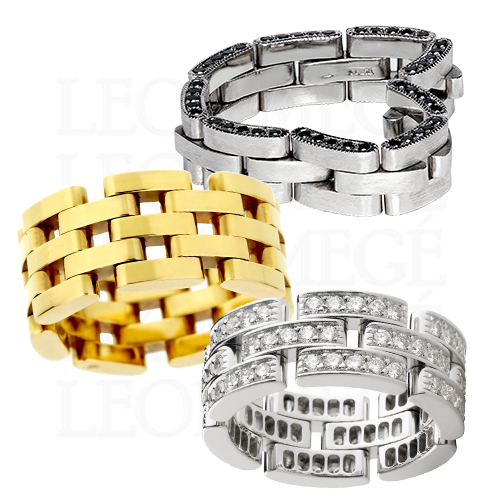
Hinged, articulated, and flexible wedding bands all refer to the same underlying design, different terms, and the same clever engineering. This relatively modern style draws inspiration from the articulated links found in bracelets and necklaces, adding a touch of movement and innovation to the traditional wedding band.
What Are Flexible Wedding Bands?
Flexible wedding bands are designed to enhance both comfort and safety compared to traditional rigid rings. Instead of a solid, continuous metal structure, these bands are constructed from multiple interconnected links. This segmented design allows the ring to flex naturally with the finger movements.
Ring avulsion, sometimes called ring degloving, is a relatively rare injury happening when a ring is suddenly caught on something or forcefully pulled from the finger. It may cause significant skin abrasion and even tearing of skin tissue. While ring avulsion injuries are uncommon, they are an important consideration for individuals who work with their hands or in environments where a ring may be exposed to sudden force or impact, such as construction, mechanical work, fitness training, or even everyday household tasks.
How Articulated Bands Improve Safety and Comfort
The key advantage of a flexible wedding band lies in its ability to redistribute force. They hug the finger with a smooth, feline-like motion.
If the ring is caught or pulled:
- The structure absorbs and disperses pressure across multiple points
- The movements at joints amortize and reduce the strain concentrated on a single area of the skin
A flexible band cannot completely eliminate the risk of injury, but it can provide an added layer of protection in higher-risk environments.
Ergonomics of Flexible Band Style
Beyond safety, these bands are valued for their superior comfort, especially for those with active lifestyles.
They are particularly well-suited for:
- People who routinely do manual work with their hands
- Those who often experience hand swelling
- Individuals who find traditional, rigid rings restrictive
- Physical activities such as fitness, weight lifting, or boxing
Because the band moves with the finger, it reduces pressure points and allows for a more natural, ergonomic fit.
Durability and Maintenance of Flexible Wedding Bands
Articulated wedding bands are a practical long-term option when properly cared for. Due to their mechanical design and unavoidable friction between parts, flexible rings may require maintenance over time.
The pivot joints and links that give the band its flexibility can gradually wear out. However:
- Individual parts can be serviced, and worn-out components can be replaced
- Routine inspections help extend the life of the ring
- The band’s functionality and integrity can be restored by any professional jeweler using standard tools and equipment
Are Flexible Wedding Bands Right for You?
A flexible or articulated wedding band may be the right choice if you:
- Work in an environment with a higher risk of ring snagging
- Prefer a more comfortable, fabric-like fit
- Want a stylish alternative to traditional wedding bands
- Value both everyday wearability
For many wearers, these bands offer a thoughtful balance between design innovation, comfort, and injury safety.