
Single-Cut Diamonds: Small Stones, Intense Brilliance
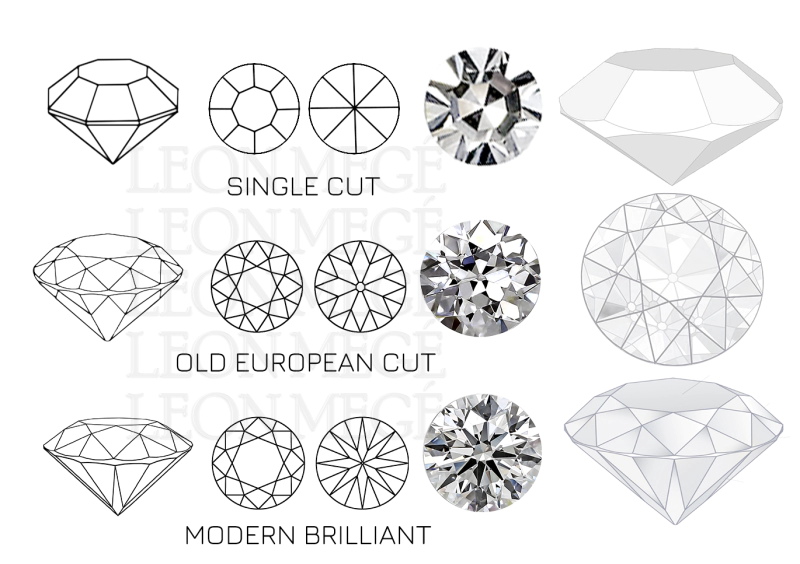
| Full Cut (58 Facets) | Single Cut (17 Facets) | |
|---|---|---|
Facet Size |
Microsopic/Granular |
Broad/Defined |
Light Return |
Maximum Brilliance |
High Dispersion (Fire) |
Optical Effect |
“Crushed Ice” effect (Hazy Glow) |
High Contrast (“Chiarascuro” effect) |
Visual Impact |
Garland Lights Effect |
Reveals Crisp Star-like Pattern |
Cost |
Plentiful and inexpensive |
Priced at premium due to scanty production |
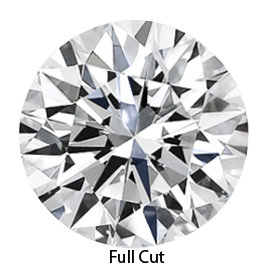
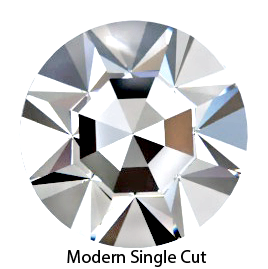
Single-cut diamond, frequently called eight-cut, is a halfway step in the faceting of a standard round brilliant. Their distinct optical advantages, particularly in small size,s despite being often viewed as a precursor to the full-cut diamond.
The single-cut diamond is the foundation of modern diamond cutting. It was the first intentional use of geometry to manipulate light within a stone instead of just reflecting it. Every brilliant-cut diamond today is a descendant of the early grindings done on a Flemish polishing wheel in the 15th century.
Optical Superiority in Small Sizes
Single-cut diamonds in small sizes (typically under 10 points) outperform full cuts in their ability to reflect and disperse light. Because of their large facets, single-cuts produce crisp, broad flashes of light, as opposed to the blurry brilliance of the same size full-cuts. Early versions were octagonal, but with the advent of diamond-bruting lathes in the 19th century, they were given round outlines.
Anatomy and Appeal of The Single Cut Diamond
The Single Cut is one of the oldest diamond cuts. It is a very simple cut, essentially an upgrade from the Table Cut, which the Point Cut preceded. The Point Cut diamond is a naturally formed octahedron crystal that is polished but not faceted. With the advancement of diamond cutting techniques, the square Table cut gave way to the octagonal Single Cut.
A single-cut diamond has a minimalistic faceting:
- 17 Facets: Comprising a table, eight crown facets, and eight pavilion facets.
- 18 Facets: Occurs when there is a culet.
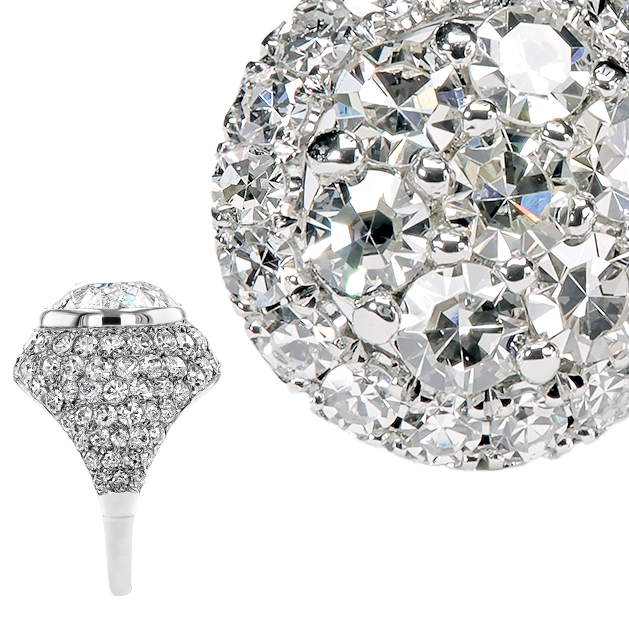
The appeal of the single-cut diamond lies in its unique properties, which make it ideal for micro-pave settings. Single-cut evolved from its humble origins as a rudimentary shortcut in faceting. Nowhere is this more evident than in high-end Swiss watches and the world of artistic haute joaillerie. Few designers have leveraged single-cut’s superiority as masterfully as Joel Arthur Rosenthal, known as JAR. Leon Mege’s creations demonstrate how single-cut diamonds can be orchestrated into complex surfaces alive with texture, luminosity, and multi-singularity. Single-cut diamonds remain the preferred choice for maximum luster in intricate, small-scale, pavé-ntensive jewelry designs.
The History of Single-Cut Diamonds
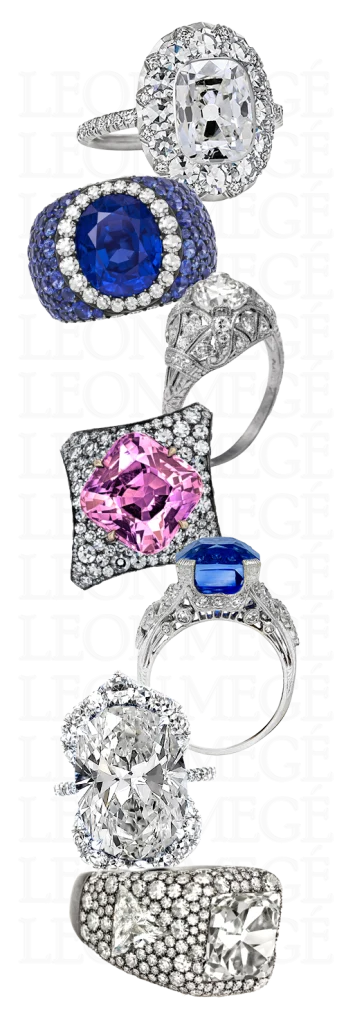
The Single Cut stands as one of the most storied silhouettes in gemology. It represents a vital evolutionary step from the Table Cut, which itself succeeded the Point Cut: a naturally formed octahedral crystal polished to a sheen but left without facets. As cutting techniques advanced, the rigid geometry of the square Table Cut transitioned into the elegant, octagonal form of the Single Cut.
Historical Prominence
Single Cuts reached their zenith in the 1920s. They were the quintessential accent stones of the Art Deco era, providing the necessary luster to complement the larger antique-cut diamonds favored in that period’s architectural and geometric designs.
Origins: The Medieval Point Cut
The story of the single cut begins on the Silk Road, where merchants were hauling purses full of shiny pebbles from India to Medieval Europe. Back then, diamonds were prized largely in their natural octahedral form of two pyramids joined at the base. Lapidaries lacked both the tools and the understanding to alter them significantly. These “point cuts,” as they came to be known, were set directly into jewelry with little modification, their value resting almost entirely on their rarity and hardness.
It was not until the 14th century that craftsmen began experimenting in earnest. The earliest recorded diamond polishing occurred in Venice and later in the Low Countries, particularly in Bruges and Antwerp, where the diamond trade began to flourish. Lapidaries working with primitive laps, iron wheels, and diamond dust as an abrasive discovered that by grinding the tip of the natural octahedron flat, they could create a “table” facet that reflected light in a new and striking way. This table cut, developed in the early to mid-1300s, is considered the immediate forerunner of the single cut.
The Birth of the Single Cut
In the late 14th century, cutters had further refined the table cut: the single cut, sometimes called the “eight cut.” The form was deceptively simple: a crown (the upper portion) featuring a flat table, four corner facets called “bezels,” and four triangular “star” facets, paired with a pavilion (the lower set of corresponding facets), yielding a total of between 16 and 18 facets in its fullest expression.
This revolutionary development demonstrated, for the first time, that a diamond can be re-shaped not merely to remove irregularities, but to control and redirect light. The single cut was first to have its geometry deliberately modified to enhance the light return of a diamond.
The Low Countries, Antwerp in particular, became the center of this new craft, thanks to the influx of Sephardic Jews unrivaled in their diamond cutting skills. The new merchandise attracted the patronage of European royalty and the emerging middle class. The diamond-cutting guild in Antwerp, established in the 15th century, formalized training and protected the secrets of the trade. It was here that the single cut reached its first Golden Age.
The Renaissance and the Age of Royalty
Throughout the 15th and 16th centuries, single-cut diamonds adorned the most powerful figures in Europe. They appeared in the crowns and rings of the Valois kings of France, in the jewel collections of the Medici, and in the elaborate court dress of Tudor England. The simplicity of the cut suited the goldsmithing of the period, which often relied on enamel, colored stones, and intricate metalwork to carry a piece visually, with the diamond serving as a point of white brilliance rather than the sole star of the show.
Portrait paintings of the Renaissance offer some of the best surviving evidence of how these stones were worn. Hans Holbein’s meticulous depictions of Tudor courtiers show single-cut diamonds set in table-cut style, flush in heavy gold mounts, catching light from the candles that illuminated grand chambers. The stones were small by modern standards – rarely more than a few millimeters across – but their rarity and cost made them objects of extraordinary prestige.
One of the most famous historical gems, the Sancy Diamond, was originally a single-cut before being re-cut later.
The Transition: Towards Greater Complexity
The late 16th and 17th centuries brought a growing desire for more brilliance, more fire, and elaborate design. As candlelit interiors became the place to mingle and socialize, demand grew for diamonds that sparkled rather than merely gleamed. Cutters began experimenting with adding more triangular facets here and there, eventually arriving at the round version of an “old mine cut” bridging single and full cut faceting.
Then came 1670, when Vincenzo Peruzzi, a Venetian stone polisher, developed (though disputed by many) the first round brilliant cut with 58 facets arranged to maximize the internal reflection and refraction of light. This new cut rendered the simplicity of the single cut suddenly old-fashioned, at least in large stones.
Yet the single cut did not disappear. For small diamonds that are less than two millimeters, it remained the practical choice well into the 20th century. The physics of the brilliant cut require a certain minimum size to work effectively; below that threshold, the additional facets crowd and overpower each other for no benefit. The single cut, with its large facets, continued to perform adequately in pave settings where miniature diamonds work as accents to larger gems.
The Modern Era: Melee and Revival
During the 18th and 19th centuries, when the round brilliant cut ruled the diamond world, the single cut held its place as a staple of jewels rich with pave and an irreplaceable tool in a jeweler’s arsenal.
In the early 20th century, the diamond production reached an industrial scale, bringing a degree of standardization. Single-cut melee was produced in large quantities for the mass jewelry market, and the Art Deco movement of the 1920s and 1930s, with its geometric precision and emphasis on light, found the single cut a natural complement to its architectural designs. Platinum settings from that era were often adorned with rows of single-cut diamonds, creating an intricate display of dancing light.
By the end of the 20th century, advancements in automated cutting technology made full-cut melee diamonds more economical to produce, leading to a decline in single-cut stones. However, these stones remained valued by antique dealers and collectors for their historical authenticity, and some high-end jewelers still used them in reproductions and antique-inspired designs.
Single Cut Diamonds Today
In recent decades, there has been a strong revival of interest in single-cut diamonds. The flourishing antique and estate jewelry market increasingly demands pieces with their original stones intact, single cuts, old miners, and old European cuts. Replacing a Georgian ring’s missing pave stone with a modern full-cut brilliant diminishes both the historical integrity and the value of the original.
There is an aesthetic appeal to single-cut diamonds that modern jewelers are rediscovering. With fewer facets, these diamonds produce a softer, more diffuse light, often described as a “glow” rather than the sharp sparkle of modern brilliant cuts. In candlelight or incandescent lighting, single cuts offer a warmth and intimacy that their modern counterparts may lack, making them popular among designers of antique-inspired or romantic styles.
Identification: Modern vs. Old Single cuts
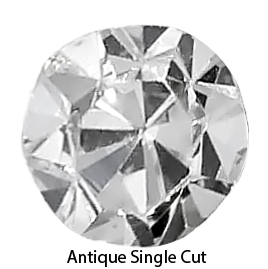
Distinguishing between eras is often straightforward: unlike their antique predecessors, modern Single Cuts do not feature open culets, resulting in a crisper, more unified appearance at the base of the stone. There is a stark distinction between the diamonds of the past, polished by hand under poor lighting using rudimentary magnification, versus today’s high-performance cuts:
- Antique Single Cuts: Because these were fashioned by hand under flickering, dim light, they often exhibit irregular proportions, uneven facets, and poor symmetry. To some, these “imperfections” are the source of their vintage charm; to others, they are malformed. Today, they are primarily used to maintain historical integrity when repairing or “filling in” vintage pieces.
- Modern Single Cuts: In contrast, contemporary Single Cuts are engineered with high-precision technology. These stones boast flawless symmetry and exceptional light performance, allowing them to command a premium price in the luxury market.
Single Cuts Diamonds in Luxury Watches
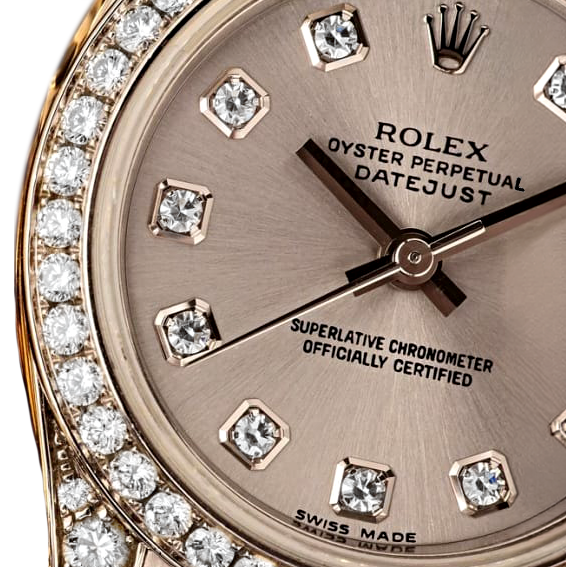
In luxury watchmaking, single-cut diamonds, typically under 0.02 carats, are used to set bezels, dials, and indices. Their small size allows for densely packed pavé settings along lugs, crowns, and case flanks, creating dazzling surfaces that highlight the mechanical artistry underneath.
Houses like Rolex, Cartier, Chopard, and Piaget have long incorporated single cuts into their gem-set collections, recognizing that the stone’s aggressive faceting actually harmonizes better with a watch’s polished metal surfaces.
There is also a deeply aesthetic dimension to the single cut’s continued relevance. Because of their uncomplicated faceting, single-cut diamonds can be consistently polished to the precise tolerances demanded by fine watchmaking.
A luxury watch bezel can feature well over a hundred pavé-set diamonds, each one contributing to a continuous field of light. At that scale, visual uniformity is absolutely critical. Even the slightest inconsistency in facet alignment or stone proportions can disrupt the surface, breaking the illusion of seamless brilliance. Its restrained geometry allows for far greater consistency from stone to stone. With fewer facets, each diamond reflects light in a controlled and predictable pattern, making it significantly easier to achieve a perfectly uniform appearance across the entire setting.
The result is a surface that appears to the viewer as a finely woven fabric of light rather than as a collection of individual stones. In high watchmaking, where precision is everything, that level of harmony is not a luxury; it is the standard.
Single Cut Diamonds in Micro Pave
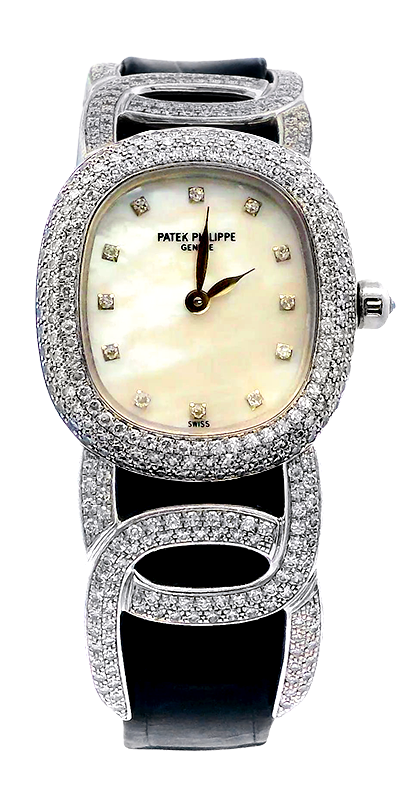
The technical distinction between single cut and full cut diamonds in micro-pavé centers on optical physics, specifically how light interacts with facet surface area at a microscopic scale.
Surface Area and Light Refraction
Micro-pavé is typically set with stones sometimes as small as 0.5 mm. If a diamond of this size has 58 facets, each facet becomes extraordinarily small. To put it in perspective, it’s like shrinking a 3-carat round brilliant down to the size of a grain of sand. At that scale, individual facets approach the threshold of human vision – the size of some types of human white blood cells.
Crushed light: facets on a one millimeter full cut diamond are so small that they approach the wavelength of visible light, causing light to scatter rather than produce a laser-crisp reflection. The result is “scintillation noise,” where the eye sees a flat, faint glimmer without contrast.
Chiaroscuro lighting: With only 17 relatively large in relationship to diamond diameter facets, single-cut catch and return light in substantial, more cohesive “blocks,” with intense, dramatic reflections. The deep shadows and bright highlights produce volume, texture, and mood. The Italians’ name for this use of contrast between light and dark is “Chiaroscuro,” an artwork technique that originated in the Renaissance, and used by legendary artists like Caravaggio, Da Vinci, and Rembrandt.