Essential Reads
A wedding band is more than just another piece of jewelry. It is a simple, enduring symbol of unity that signals you are no longer available to the opposite sex. The traditional wedding ring is a solid metal band with a domed profile and a flat inner surface with chamfered edges. It remains the most popular style among men. Women prefer slimmer bands, typically set with diamonds in an eternity style.
The interior of a wedding band can be flat or slightly rounded. The commercial-grade standard pipe-cut bands are flat on the inside, making them lighter and cheaper to produce.
The more luxurious version of a wide band, known as Comfort Fit in the United States or Court in Britain, has an inner curvature. This rounded surface helps the band slide onto the finger more easily. A Comfort-Fit band is particularly practical for those who frequently remove their ring, such as medical professionals.
This difference between the two band styles is felt mostly when putting the band on the finger, but not during wear.
For narrow bands under 3.0 mm in width, a properly chamfered edge is a more appropriate solution. Because a slender band exerts less pressure on the finger than a wider one, it can be put on or removed with ease, without requiring a pronounced interior curvature.
Comfort-Fit profiles vary in degree. Light Comfort-Fit has a gentle interior curve, while Heavy Comfort-Fit has a more pronounced one. There is no universal standard; each manufacturer has its own template.
All Leon Mege wedding bands, regardless of their width, are finished with our Effortless Glide™ edge, a subtle chamfer, and a highly polished interior that allows the ring to slide on smoothly while maintaining a secure, comfortable fit.
Selecting the right profile for a wedding band depends on several factors:
Whether the band will be worn permanently alongside an engagement ring or only on special occasions is an important consideration in selecting its size and design.
For most people, the choice comes down to balancing comfort, durability, and visual harmony.
While the differences between profiles may appear subtle at first, they greatly influence how a wedding band looks on the hand and feels during everyday wear.
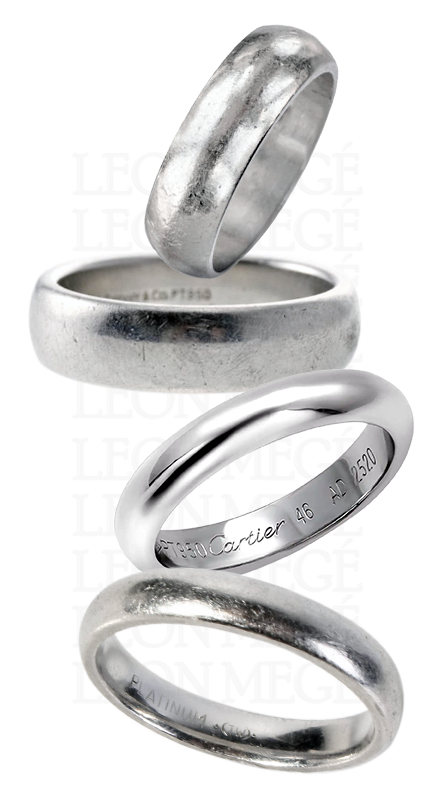
The most popular and enduring style is the classic dome band. Its outer profile is a sleek arc, while the interior is flat or rounded. The dome band is valued for its comfort, durability, and traditional minimalism. The dome band is valued for its comfort, durability, and traditional minimalism.
The traditional British Court has an oval cross-section with pointed ends. In the United States, this rounded interior is called Comfort Fit. The rounded interior allows the ring to slide more easily on a finger while maintaining a firm grip.
There are several variations of the Court profile:
These variations maintain the same fundamental geometry while offering stylistic differences.
The Cushion profile features an oval cross-section with high shoulders. Its gently curved surface and broad corners create a modern silhouette, softened by rounded edges.
A well-known example was the Lucida wedding band introduced by Tiffany & Co. in 1999, as a companion to its Lucida engagement ring collection, billed as a “modern classic” for the new millennium.
Despite their short-lived popularity, cushion bands are rarely chosen due to their bulky appearance.
Flat, or rectangular wedding bands, have a flat outer surface and straight sides. Picture a Klondike Ice-cream Bar wrapped around your finger.
Their typical thickness ranges from 1.0 mm to 2.0 mm. They can be made in any width to fulfill the desired look.
Because of their clean geometry and cold precision, flat bands are often described as modern or architectural. They are frequently paired with brushed, matte, or satin finishes to emphasize their machine-born character.
The band profile is perfectly circular, sometimes with a narrow, flat strip running inside (which is useful for applying hallmarks), and it adds a degree of comfort. Round bands typically range from 1.5 mm to 2.5 mm in diameter; anything thicker would cause serious discomfort during wear. Round bands appear surprisingly elegant, in stacks or standing alone.
Oval wedding bands feature a softly flattened round profile that sits comfortably on the finger.
When worn, narrower oval bands appear very similar to round bands. As the width increases, their appearance resembles a high-domed band but with a gentle, understated silhouette.
They are typically produced in widths ranging from 1.8 mm to 4.0 mm.
Concave wedding bands feature a subtle, saddle-shaped inward curve along the top’s center. This sculptural profile, popular in European design, introduces a sense of movement and restraint.
Its cross-section resembles a gentle kidney-bean curve, giving the band a distinctive and refined appearance.
Concave bands can be made in a wide range of widths, typically starting from approximately 3.0 mm.
A knife-edge band features a raised ridge running along the center of the ring. Despite the name, the profile is not blade-like; it is better understood as a triangle with softly rounded sides. This geometry reduces the visual impact, making it appear less prominent and not overtly metallic on the hand. For this reason, it is often used as a shank of bridal rings, particularly in the traditional Tiffany solitaire. As a wedding band, however, the knife-edge profile is less common, as some may find the ridge less comfortable for continuous wear.
Very thin knife-edge bands, typically under 1.0 mm wide, are occasionally used as spacers between rings to reduce friction and wear. These may also feature milgrain detailing along the ridge as a decorative finish.
Hinged, articulated, and flexible wedding bands all refer to the same underlying design, different terms, and the same clever engineering. This relatively modern style draws inspiration from the articulated links found in bracelets and necklaces, adding a touch of movement and innovation to the traditional wedding band.
Ring avulsion, sometimes called ring degloving, is a relatively rare injury happening when a ring is suddenly caught on something or forcefully pulled from the finger. It may cause significant skin abrasion and even tearing of skin tissue. While ring avulsion injuries are uncommon, they are an important consideration for individuals who work with their hands or in environments where a ring may be exposed to sudden force or impact, such as construction, mechanical work, fitness training, or even everyday household tasks.
What Are Flexible Wedding Bands?
Flexible wedding bands are designed to enhance both comfort and safety compared to traditional rigid rings.
Instead of a solid, continuous metal structure, these bands are constructed from multiple interconnected links. This segmented design allows the ring to flex naturally with the finger movements.
How Articulated Bands Improve Safety and Comfort
The key advantage of a flexible wedding band lies in its ability to redistribute force. They hug the finger with a smooth, feline-like motion.
If the ring is caught or pulled:
A flexible band cannot completely eliminate the risk of injury, but it can provide an added layer of protection in higher-risk environments.
Beyond safety, these bands are valued for their superior comfort, especially for those with active lifestyles.
They are particularly well-suited for:
Because the band moves with the finger, it reduces pressure points and allows for a more natural, ergonomic fit.
Articulated wedding bands are a practical long-term option when properly cared for. Due to their mechanical design and unavoidable friction between parts, flexible rings may require maintenance over time.
The pivot joints and links that give the band its flexibility can gradually wear out. However:
A flexible or articulated wedding band may be the right choice if you:
For many wearers, these bands offer a thoughtful balance between design innovation, comfort, and injury safety.
A classic wedding band is the most basic piece of jewelry, but its design should be carefully considered. After all, it is a nuptial symbol to be worn daily from now to eternity. Its size, width, profile, and thickness all influence how the band looks, feels, and wears over time.
The profile, or the geometric shape of the ring’s cross-section, is the most important design element. Different profiles create distinct aesthetics, from traditional domed rings to rugged flat bands with a faint vibe of masculine insecurity to sculptural waves of saddle-shaped designs. *Understanding the most common wedding band profiles helps narrow the choices and ensures the ring is both comfortable and visually balanced.
The curvature of a dome band is defined by the relationship between the chord (band’s width) and the diameter of the circle from which the arc is derived.
Wedding bands are categorized by dome height (often called weight):
Some might describe it as medium-weight, heavyweight, or extra-heavyweight because a higher, more voluminous Dome requires more metal.
As a general rule, wider wedding bands tend to have a lower dome profile.
Selecting the width of a wedding band usually involves trying on different options and seeing which one feels and looks right. Comfort and proportion both play an important role. Wider bands typically suit larger hands, while narrower bands complement smaller hands or slender fingers.
The width of a band should also correlate to finger size. A four millimeter band may look bulky on a small finger, but it is too narrow on a larger hand. To achieve a similar look, increase the width of a band by about 1 mm for every 3-size increment. For example, a 3 mm band in size 9 and a 4 mm band in size 12 appear similarly proportioned.
Narrow bands (1.5–2.5 mm)
Delicate and refined in appearance, it is often favored by women and Eastern European men who prefer a lighter, understated ring.
Medium widths (3–5 mm)
The most common choice offering a balanced look that suits a wide range of hand sizes.
Wide bands (6.0 mm and above)
Bold and substantial, typically chosen by those who prioritize a strong, masculine presence, a rugged style popular with WWF contenders and Russian babushkas.
While the width establishes the ring’s visual scale, its profile ultimately defines its character and wearability. Wide rings feel tight on a finger because they displace more of the finger’s skin.
Wedding bands are measured by height (sometimes called depth) and width. The term “thickness” is confusing because it can refer to either width or height. The band’s height extends from the finger to the top. Wedding bands are typically less than 2.5 mm thick to prevent discomfort during wear, though this can vary depending on their width and desired profile. Wider bands have a lower profile to avoid getting uncomfortably high.
Thin 0.6 – 1.2 mm Suitable for wide, flat bands, easier to bend or warp (especially gold)
Low height bands 1.2 – 1.5 mm, Slim but more comfortable on a finger
Common for dainty or stackable bands and relatively narrow bands
The standard height (most common range) for most profiles is 1.5 – 2.0 mm. Best balance of:
Heavier bands over 2.5 mm in height offer a solid, substantial feel, but they are not for everyone. The height tolerance is related to the hands’ anatomy and size. The pressure from a thick band, even worse, square one, on adjacent fingers will bother most people. Better for:
Milgrain is a decorative edge commonly found on wedding bands, well-suited for traditional marriage ceremonies. Typically, a thin milgrain border runs along the side of a specially shaped domed wedding band.
A milgrain wedding band carries an unmistakable old-world sensibility, reserved, deliberate, and quietly aristocratic. It evokes a certain preppy restraint: less spectacle, more pedigree. The kind of detail that doesn’t ask for approval, but rewards attention. Milgrain is not an ornament for its own sake. It is a sign of restraint, discipline, and sophistication.
A fully encircled eternity band carries a meaning that goes beyond simple adornment. The unbroken line of brilliant gems symbolizes permanence, an enduring union that will last beyond our lives. The continuous line that closes on itself reinforces the meaning of eternal union that does not end or dissolve at some future point.
Unlike an engagement ring that has a keystone marking the top, a wedding band spins freely on the finger, exposing bare metal all the time. The partially set band looks unfinished, unresolved, and stylistically neglected.
The true significance of a wedding band lies in its seamless consistency and endless appeal. It is not simply a design of choice, but a statement of permanence, love, and completeness.
Platinum is perfect for bridal jewelry whose purity resonates with the sanctity of marriage. Choosing the right metal is personal, and each material has advantages and disadvantages, but platinum always comes out on top thanks to its rarity and resilience. Platinum has always been a preferred metal for bridal jewelry because of its naturally soft white color and beautiful luster. Its neutral color that doesn’t tarnish or oxidize makes color coordination a snap. Platinum is almost twice as heavy as gold. It feels substantial and constantly reminds you of your marital obligations with its presence. Aged platinum develops a dignified, noble patina, a unique appearance, impossible to reproduce mechanically, best described as distressed “shabby chic,” reminiscent of shimmering rustic silverware punctuated by microscopic dings.
Gold costs almost three times as much as platinum. Why are platinum bands more expensive?
Despite surging gold prices, platinum jewelry is still worth more for a number of reasons:
Silver – defense against vampires or a New Age fad?
Once more valuable than gold, silver has been prized for centuries. However, its relative softness has hampered traditional use for making wedding bands, and silver tarnishes very quickly. Pure silver is too soft to be used in jewelry; it must be alloyed with copper to boost its strength. Sterling silver contains at least 92.5% of pure silver.
Gold wedding bands
Gold wedding bands have been on the decline since the 70s. Historically, its rich yellow color was a significant draw, but today, gold is increasingly a symbol of excess and insensitive extravagance. Women and men have been shunning it for many decades now, and it appears that gold is not making a comeback in bridal jewelry. For example, in an episode of the popular Sex and the City, the yuppy icon, Carrie Bradshaw, is dry-heaving at the news that her boyfriend is getting her a gold ring.
Rose gold
Pink gold is an upscale alloy associated with wealth, glamour, and grandeur, but it lacks the glitz and extravagance of its yellow cousin. Pink, red, or rose gold (the same thing; “rose” sounds more romantic) is highly durable and resistant to scratches and dents. It owes its beautiful, tender color to a higher share of copper in its alloy. Copper is also responsible for rose gold’s exceptional hardness, which makes high-luster polish possible.
Rose gold owes its prominence to Russians, who used it in all types of jewelry, from Carl Fabergé’s famous Easter eggs to tea kettles for wealthy merchants. In Russia, up until very recently, pink gold was considered the natural gold color, earning it the nickname “Russian gold.” There are a few drawbacks—even 18k rose gold tarnishes fairly quickly. It is also more difficult to hand-forge.
Is a white gold band a good option?
White gold is a poor choice for a wedding band. Created as a platinum substitute (a scarce strategic asset during the war), white gold remains a poor stand-in for the real white metal of the jewelry world. White gold is usually plated with rhodium to conceal its yellow tint. A thin layer of rhodium (a white metal in the platinum group) is applied to the surface, giving white gold its bright white shine. Rhodium is very hard, so it provides a degree of protection from scratches until its thin layer wears or peels off. That’s why white gold jewelry must be “dipped” repeatedly to reapply rhodium.
Some jewelers falsely claim that their white gold alloy is so white that it does not require rhodium plating. It’s not true; all white gold alloys have approximately the same hardness. Consumers are also often misled into thinking white gold is harder than platinum. This is false; platinum is harder.
Traditionally, the British Royal wedding bands, including the one Queen Elizabeth II, wears, are fashioned from rare Welsh gold. It sits behind her engagement ring set with diamonds ripped from her late husband’s mother’s tiara. Prince Charles wears a gold signet ring layered with his Welsh gold wedding band on his left hand’s little finger in a medieval fashion. Is it a sign of his individuality, as he claims, or a clever life hack to halt the finger from sliding onto his enormous schnozzle?
Meghan Markle’s wedding band is made from the same Welsh gold stash used for royal rings. Prince Harry’s platinum wedding band has a textured finish that pairs well with Nazi costumes. Princess Eugenie caused a stir when her Welsh gold wedding band was too tight for her souped-up fingers during the wedding ceremony. After three years of dating, Nancy Reagan was married to Ronald for 52 years. She didn’t wear an engagement ring, but she wore a platinum diamond wedding band.
Hillary Clinton reportedly turned down an engagement ring in favor of pork futures. She and Bill exchanged family heirloom wedding bands.
Mr. Obama’s wedding band was a thick, carved gold band from Indonesia, where he lived from age 6 to 10. The conspiracy theory that Mr. Obama’s wedding ring was inscribed with the first half of the Islamic declaration of faith, the Shahada: “There is no god except Allah,” is a hoax.
Melania Trump wears a 13-carat platinum eternity band with fifteen emerald-cut diamonds. The rumors of a Q diamond color are baseless. Supposedly, Donald bartered the $200k Graff eternity band worth $1.5 million for TV promotions on The Apprentice.
A quick look at celebrities gives us a great insight into the broad scope of wedding band styles. They rip through scores of marriages faster than fire through a box of matches. Each marriage has a wedding band that is different from the one before. Celebrities have a pompous habit of attributing deep spiritual meaning to their jewelry to justify their extravagant vanity. The PR helps with landing cushy movie roles without visiting Weinstein’s stained couch.
During a secret civil ceremony, Joe DiMaggio presented Marilyn Monroe with a platinum channel-set band with 36 baguettes. It wasn’t her only wedding ring, but it was sold for $772,500 at Christie’s in 1999, even though one baguette went missing. An astonishing price for the mediocre band worth less than $20,000 even today. It took about a baguette per week to keep the two American icons in an enduring romantic relationship that lasted only nine months.
Before Jennifer Lopez’s marriage ended in divorce, she often ditched her gold wedding band because it just didn’t go with her platinum rings. Most fashionistas agree that mixing gold and platinum jewelry is a big no-no.
Before her divorce from Kanye West, Kim Kardashian wore an ultra-thin platinum micro pave band – a surprisingly understated piece for her luscious form.
Carrie Underwood wears a curved diamond wedding band to accommodate her engagement ring. The platinum shadow band is said to be as unique as her singing style.
Scarlett Johansson wears a thick gold wedding band as per the Russian heritage requirements. Russian women favor bands as wide as a truck tire.
Chris Pratt wears a plain gold wedding band. In the movie “Passengers,” his character crafts a wedding band using platinum stripped from the spaceship’s fusion reactor. At least, that’s what they want us to believe. We think he steals the ring from a jewelry boutique onboard.
Adam Levine got a plain platinum band for himself and a finger tattoo for his Namibian-born shiksa. “The tattoo is still there when I take my engagement ring off,” she said. “Wow, that was cheap,” he thought.
Amal Clooney’s dainty micro pave band sits flush against the platinum engagement ring she got from George. It’s not a million in a Tumi bag that each of his pals got from him, but still a nice gesture.
Gold, silver, and platinum aren’t your only metal options when buying a wedding band. From traditional to ultra-modern, there are plenty of materials to consider.
Medical personnel can remove zirconium, titanium, and steel rings from the finger using special ring cutters. Still, it’s a major headache, so medics will not appreciate your taste in alternative metals.
Palladium is a naturally white metal that is visually indistinguishable from platinum. It is one of the rarest metals on Earth. A decade ago, palladium was considered a cheap platinum substitute, costing a fraction of platinum’s price. Today, palladium is twice as expensive as platinum. Even Bitcoin millionaires will think twice before ordering a band made out of palladium. Palladium is lighter than platinum, very durable, and hypoallergenic.
Titanium is among the strongest and most lightweight metals for wedding bands. Those exhausted from wearing heavy platinum bands can finally be relieved by titanium’s almost plastic-like heft.
Stainless steel rings are strong and cheap. They can be polished to a shiny chrome finish or brushed for a pewter look. Either way, you’ve got yourself a shiny piece of hardware.
Damascus steel rings are made of two alternating types of stainless steel layered together to create striped patterns. Some layers are chemically darkened to add a dramatic contrast similar to zebra skin.
Meteorite iron is often incorporated in wedding bands combined with other metals, such as titanium, platinum, and gold. Stellar-born superheated meteorites fallen on Earth slowly cooled over billions of years, causing iron molecules to settle into a crystalline Widmanstätten pattern that does not occur elsewhere on Earth. Tungsten, or Wolfram for Krauts, is a silvery metal identified as a new element in 1781. It is four times harder than titanium and hypoallergenic but, unfortunately, prone to shattering. Because of their hardness, tungsten rings have a brilliant, vitreous shine.
Tungsten rings cannot be sized, but this is rarely an issue. Tungsten rings are very inexpensive and can be easily replaced.
Cobalt is a bright white metal known as “poor wife’s platinum.” It is heavier than other non-precious metals, which gives it a substantial feel. It’s perfect for those who want to always keep in touch with their wedding vows.
Ceramic wedding bands may look cool at first, but they are more appropriate for teenagers. They are so cheap that you may want to marry a few more times to enjoy the bargain.
Wood can be found in wedding bands as an inlay in titanium, ceramic, or tungsten. Whole rings may also be carved out of a solid piece of wood. These rings are not indestructible and require extra care to stay presentable. On the plus side, they’re dirt cheap.
Dinosaur bone rings contain fossilized bones of Barney and his friends. His remains are cut up and used for inlays combined with meteorite iron, exotic wood, or other equally fascinating materials. A grim reminder that our remains might end up in family court one day.
Zirconium is a grayish-white metal that is similar to titanium but has a ceramic-like feel to it. Zirconium is shatter-proof, relatively lightweight, skin-friendly, and cheap. Zirconium darkens when exposed to oxidation, so zirconium bands are usually jet-black. Zirconium is used in nuclear reactors due to its high heat and corrosion resistance, so it’s a safe bet that Homer Simpson wears a zirconium band.
Antlers of many different species, colors, and textures are used as an inlay material in wedding bands, serving as a constant reminder of senseless animal murder. Some animals died before their remains were dug out and desecrated.
Carbon fiber is a very lightweight, durable material made from organic polymers. These wedding bands are made entirely from carbon fiber or used as inlays. Carbon fiber rings are pretty durable and cheap.
Mokume-gane is a highly specialized technique perfected by the Japanese of imitating wood-like texture on a metal surface (hence the name: mokume – wood grain and gane – metal 木目金 ). Various metals and alloys are fused to produce a laminate with a uniquely patterned finish. This stock is used for making wedding bands.
Denbei Shoami, a Japanese metalsmith, is credited with inventing the technique for decorating samurai swords. Like wood graining caused by naturally alternating harder and softer layers of wood, the patterns in mokume gane are due to each metal’s different physical properties – hardness, toughness, resistance to corrosion, etc. As pretty as they are when new mokume gane bands quickly deteriorate and lose their look. They generally cannot be sized and cost too much for a novelty item.
A shadow wedding band has a curved section that fits flush next to an engagement ring. Useless on its own, the band has many different names such as “curved band,” “fitted band,” “molded band,” “custom shaped band,” or “waveband.” The aesthetically challenged wavy band looks awkward and makes no sense as a symbol of marriage.
The “Rolling” band is a name coined by Cartier for interlinked multicolored bands symbolizing all aspects of a relationship: white is for friendship, pink is for love, and yellow is for fidelity. Each band, a set of several, usually three, is connected to the other two, allowing them to slide on the finger easily by rolling over each other. The Cartier Trinity band is one such example. A rolling band finger size cannot be measured on a ring stick – it must be tried on.
According to legend Jean Cocteau saw Saturn’s rings in a dream, and his friend Louis Cartier turned the dream into a reality circa 1924. The ring design existed long before Jean and Louis went interstellar; such bands were commonplace all over Eastern Europe. However, Cartier beat Russians and Poles to the punch expropriating the design to call its own.
The mathematically derived templates developed by Leon Megé over decades of research maximize elegance and comfort in the final product. Leon Megé bands are distinguished by refined lines: precise, elegant curvatures that determine the look of any classic wedding band.
Leon Megé forges traditional, upscale wedding bands from high-grade platinum, sealing rough spots with a high-frequency laser beam. There are no soldering joints or casting seams.
Leon Megé’s bench-made classic wedding bands are available only to customers who have purchased an engagement ring from us.
A puzzle ring is made of disfigured links assembled tightly together so it appears solid. Once the rings have been dislodged from their places, it’s up to the wearer to solve the puzzle. The rings can be reassembled by turning each piece in a certain way following a predetermined sequence of steps. Directions for solving rings’ puzzles are usually supplied. Patience is required because forcing, compressing, or bending the parts will destroy the ring.
A ring jacket, also called a ring wrap, a ring enhancer, or a ring guard, is an old-fashioned concept that’s gone out of style but is still being used today.
A jacket is made of two connected shadow bands with a space in the middle where an engagement ring can be dropped. A ring jacket is usually a way to add a “dressier” option to an engagement ring. It also adds stability to the ring and reduces spin. A ring jacket makes it possible to update the look of a unique engagement ring without changing the ring itself.
Using a ring jacket as a wedding band is a no-no. You cannot wear it without the engagement ring, and it looks like a part of the engagement ring when worn together.
Women overwhelmingly prefer wedding bands set with diamonds over plain metal bands. Even the Orthodox Jews required to wear a solid band at the wedding ceremony often set it with diamonds once the nuptial formalities are out of the way.
The choice of a wedding band depends on how the wedding band is worn. The majority of women wear engagement and wedding rings on the same finger. This eventually causes damage from friction to both rings, so we don’t recommend it.
For those who wear both engagement and wedding rings together, a pave-set band makes the most sense. A pave band works with any engagement ring regardless of the diamond’s shape.
There are two basic styles: soft blurry outline of modern pave, and bright-cut pave with well-defined rigid edges. Engagement rings with emeralds or Asschers are complemented by bands with a bright-cut pave. A modern-style pave works well for rounded stones such as ovals, cushions, pears, marquises, and, of course, rounds.
A thin low-sitting wedding band is key to minimizing friction. The choice of a bright-cut style pave offers better protection than a modern pave. A thin, dainty pave band will stay closer to the engagement ring without a large gap in between. It’s recommended to keep the band’s width to the minimum since a wedding band should not compete but rather complement the engagement ring.
For those who wear engagement and wedding rings separately, the possibilities are endless. A woman can wear a more substantial wedding band with larger stones without potentially overpowering her engagement ring. Any diamond shape or a combination of shapes is fair game. Larger stones can share prongs, hence the name “shared-prong” bands. Eternity bands can also be bezel or channel set.
To tie both rings stylistically, pair a step-cut diamond with a step-cut-set wedding band, while a brilliant-cut band can accompany a brilliant-cut engagement ring.
Unless an heirloom band stays in the family for generations and has sentimental value, there is no reason to re-use someone else’s ring.
There are two reasons for a used wedding band to be sold: whomever it was made for, it didn’t work, or its owner passed away, and the surviving party did not feel overly attached. Do you want this twisted karma to affect your eternal happiness? We all know that curses and jinxes are silly superstitions, but would you like to spend your married life proving that?
Unlike an engagement ring, a wedding band is usually not that expensive. If you cannot afford gold or platinum, get a silver one. Still too expensive? Steel, wood, or ceramic bands are super cheap.
A wedding band is worn nonstop, so ensuring it’s entirely safe for your skin is a priority. “Hypoallergenic” metals are those that are least likely to cause an allergic reaction. All metals except platinum can cause an allergic reaction.
Moisture from frequent hand washing or swimming can be a possible cause of skin irritation. Perspiration, lotions, and household chemicals trapped under the wedding band can also cause irritation. Cleaning your wedding band regularly and drying it thoroughly after washing your hands can rule out allergies. If you continue to have irritation caused by your wedding band, consider getting a divorce.
Nickel, zinc, copper, and lead used in metal alloys can cause allergies. Nickel allergies are prevalent and quite severe. European Union bans the metal from use in gold alloys. Unfortunately, the majority of white gold jewelry sold in the US is made with nickel alloy. It is worth noting that Leon Mege jewelry is never made using nickel alloy. If you are aware of any metal allergy that you might have, you can contact us to make sure the ring you’re interested in is safe for you.
Since the human body does not react to platinum and palladium, these metals are used for biomedical applications. Both are completely safe for people with sensitive skin. Platinum is 75% denser than palladium and 20 times as dense as water. Palladium is a precious silver-colored metal very similar to platinum in appearance. It’s almost as light as gold but more pliable. Both metals can be formed into virtually any shape and suited for all jewelry applications.
Yellow gold is generally hypoallergenic if it contains a minimum of 75% of pure gold – 18k or higher. Copper and silver used for alloying gold rarely cause adverse reactions, but zinc occasionally does. Gold alloys are significantly less hypoallergenic than platinum or palladium. White gold should be avoided because there is a strong chance it contains poisonous nickel.
Cobalt is a scratch-resistant, cheap, dark silvery metal used to make wedding bands. It is used in dental and orthopedic implants for its hypoallergenic properties and durability. You can also consider surgical stainless steel, whether it fell from the sky in meteorites or was melted by humans. Stainless steel wedding bands are cheap and safe to wear. When everything else fails, consider zirconium – a lightweight and hypoallergenic material. You can’t go cheaper than that.
Retailers love matching wedding band sets, and what’s not to love – two sales with one sales pitch. A matching set usually consists of two same metal but different styles bands or similar style bands in a different metal. When the couple is together, matching bands are so sugary sweet you can get diabetes just by looking; when they are away from each other, nobody will know anyway.
His’n’her’s wedding band sets are popular in Europe, where couples are not embarrassed to wear identical rings. Such conformity of tastes between a man and a woman is unhealthy. Women deserve something more special, beautiful, and feminine. Men require something more masculine and straightforward.
There are exceptions, of course, but we advise dismissing the idea of a matching wedding band set. Show your individuality! Otherwise, we would end up marching in goosestep, wearing identical Hugo Boss uniforms and saluting each other with the right arm extended at a 30-degree angle.
The hardness of platinum and white gold alloys is based on the Vickers scale (HV). The higher number indicates a more rigid metal. There is a significant difference in hardness between hand-forged (cold-forged) metal and metal produced by casting.
How metals stack up from the softest to the hardest:
110 HV – 5% iridium platinum cast – incredibly soft, not suitable for hand-forging
130 HV – 5.0% ruthenium platinum cast
135 HV – 4.5% cobalt platinum cast, the relatively soft magnetic alloy used in mass production
150 HV – 18k yellow gold cast
190 HV – 18k palladium white gold cost
210 HV – 18k hand-forged yellow gold is used for bench work. High-end jewelers use 18k gold exclusively.
216 HV – 18k palladium hand-forged white gold. This alloy is rarely used because of palladium’s high cost. Platinum is the better option.
220-230 HV – 5.0% ruthenium hand-forged platinum. Used in high-end jewelry. All Leon Megé jewelry is made using this alloy.
220 HV – 18k nickel white gold. This alloy has a significant yellow tint. It may cause severe allergic reactions and is illegal for use in jewelry in the European Union.
350 HV – 14k nickel white gold – rock-hard, dangerous, pale yellow, allergy-causing alloy, illegal in the European Union.
There are many different types of wedding bands unique and memorable, and there is hardly any need to personalize them.
For those whose ego yearns for more, hand engraving or setting a secret birthstone is a solution. Both are popular and affordable options for adding a personal touch to a wedding band. An engraved wedding date can also help to avoid the embarrassment of forgetting an anniversary. There are also various novelties, such as a digitally enhanced fingerprint molded on the band.
Very thin, flat bands can be used to separate a wedding band from an engagement ring to avoid damage from friction. This is a viable option if both rings have pavés, especially on the sides where they would be touching.
A spacer can also be added to a stack as an accent to vary the mix.
Engraving is the art of decorating metal by incising a pattern of grooves onto its surface. An engraving can be an inscription or a pattern. Cheap machine engraving, the type used for personalizing trophies or dog tags, is done with a marking machine or a laser.
Genuine engraving is done by hand using a special tool made of tempered steel. It’s called a “graver” (“burin” or “échoppe” in French, “stichel” in German). A professional engraver is an artist who uses metal as a medium. Precise work on a microscopic scale is challenging. Very few people are capable of such meticulous craftsmanship.
A hand inscription is an excellent way to make a wedding band special. An inscription is usually hidden inside the ring. On occasion, it can be on the outside for the whole world to see.
Engraving is done when the band is finished and polished. Therefore, it’s a good idea to try the band to ensure the perfect fit. Adjusting the size can damage the engraving, so it might need to be done again. Decorative engraving is done to hide and beautify exposed metal surfaces. It is often done on the top and the sides of a band.
An engraving slowly wears off over time and can also be damaged during ring sizing. Although an engraving can be restored, an inscription tempered by time radiates a more profound meaning and should be left alone.
Wedding bands often carry a personal inscription immortalizing the couple’s feelings towards each other. Usually, it is a line from a poem, a verse from a favorite Holy book, a Chinese letter from a takeout menu, or anything else deeply meaningful to both parties.
The limited space inside the band, already taken up by stamps and hallmarks, calls for a short, abbreviated version of an endearment. A couple of short words will do.
Engraving the wedding date is popular and even helpful. It can prevent those embarrassing moments in a couple’s life when a spouse forgets an anniversary.
The inscription is meticulously carved by a professional using a special tool. It is tedious and expensive, but the result is entirely different from cheap machine engravings you get at the mall.
Understanding Metal Finishes Every metal finish falls into one of two categories: polished or textured.…
International Shipping The cost of international shipping is not included in the purchase price; please…
[show_post id="206111"] Buying jewelry is a compulsive act of frivolous excessive callous unnecessary spending Leon…
Engagement Ring AI There are three basic engagement ring styles: Solitaire, Halo, and three- or…
Wearing a wedding band next to an engagement ring is a cause for concern and…
Revered for their incredible beauty and mythical origins, Argyle pink diamonds are highly coveted as…
This website uses cookies.