Categories: Diamonds 101

Diamond Cut

Diamond cut is a structure, design, and execution of the shape, proportion, symmetry, facet pattern, and position. Two essential types of diamond facets are step- and brilliant style. Most people are familiar with kite- and triangular-shaped brilliant facets. Round and fancy-shaped diamonds, except for emerald cuts, have brilliant faceting. Step-cut diamonds such as emerald cuts, Asscher cuts, and baguettes have rectangular or trapezoid facets. A few unusual diamonds with a mix of steps and brilliant facets are called “Mixed” cuts.

The cut significantly affects a diamond’s optical properties; it determines how well the stone reflects and breaks the light. Round brilliants with excellent cut, symmetry, and polish grade are called “ideal cut diamonds.”

Sometimes these diamonds are designated as Triple X, XXX, or ExExEX. Some ideal cut diamonds with a specific pattern of facets can be classified as “Hearts and Arrows” or “Hearts & Arrows.” The idea that an ideal cut is inherently more beautiful is preposterous. Many people find a diamond with a small degree of asymmetry more attractive. The reflections of a perfectly symmetrical diamond lack randomness that make the stone come alive. A precursor of the ideal cut, the “American Standard” cut, was developed in 1919 by Polish engineer Marcel Tolkowsky. His formula was perfected over the years, resulting in the ideal diamond cut. 

The GIA cut grades are “poor,” “fair,” “good,” “very good,” and “excellent.”

What makes a diamond sparkle?

A property called “sparkle” does not exist. The word “sparkle” refers to a combination of brilliance and dispersion. The brilliance is a repeated blinking of diamond facets in random order. At the same time, dispersion is the diamond’s ability to scatter and polarise light, causing the rainbow effect called “fire” in diamonds.

Some diamonds are cut to maximize brilliance, others for fire. Brilliant cut maximizes brilliance at dispersion’s expense. Antique and step-cut diamonds, popular when ballrooms were still lit with candles, are cut to maximize the fire.

Diamond Ratio

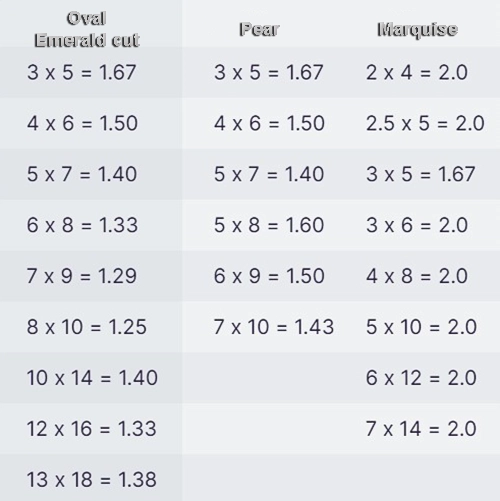
The length-to-width ratio is a measure of a stone’s elongation.  The L/W ratio is important for elongated diamond cuts such as emeralds cuts, cushions, ovals, radiants, and to a lesser degree, other shapes.

The ratio is determined by dividing the stone’s length by its width. The L/W ratio is always one for square-proportioned diamonds such as rounds and Asschers (elongated Asschers are called Krupp-cut diamonds).

Leon

Share
Published by
Leon

Recent Posts

Metal Finishes

Understanding Metal Finishes Every metal finish falls into one of two categories: polished or textured.…

4 days ago

Shipping Internationally

International Shipping The cost of international shipping is not included in the purchase price; please…

1 year ago

Price Negotiations

[show_post id="206111"] Buying jewelry is a compulsive act of frivolous excessive callous unnecessary spending Leon…

2 years ago

AI Quiz rules

Engagement Ring AI There are three basic engagement ring styles: Solitaire, Halo, and three- or…

2 years ago

Wearing rings separately

Wearing a wedding band next to an engagement ring is a cause for concern and…

3 years ago

Pink Diamonds

Revered for their incredible beauty and mythical origins, Argyle pink diamonds are highly coveted as…

3 years ago

This website uses cookies.