Garnet hardness on the Mohs scale is approximately 7- 7.5 – well suited for use in jewelry. Most garnets are clear from inclusions. Due to their relative hardness and clarity, most garnets can be faceted. Garnets occur in all colors except blue. The name ‘garnet’ comes from the Latin granatus, meaning “the pomegranate” – an ancient fruit whose seeds resemble the crystals of the most common variety of garnet – the pyrope. For centuries garnet necklaces were worn by pharaohs of Egypt, a popular sarcophagus stuffer for the afterlife. The term carbuncle was often used in ancient times to describe red garnets. Carbuncle was thought to be one of the four precious stones given to King Solomon by God.
Pyralspite Garnet Group
Ugrandite Garnet Group
Less Common Garnet Species
Garnet is a birthstone for January. Garnet is a 2nd Anniversary gemstone. Garnet represents love and commitment. It revitalizes feelings and enhances relationships by bringing warmth, devotion, understanding, trust, sincerity, and honesty. Said to control anger, although never been scientifically tested.
Tsavorite is an emerald-green variety of Grossular garnet recognized as a separate species in 1961 by Scottish gemologist Campbell Bridges. Tsavorites are found in Kenya and Tanzania. Zimbabwe and Madagascar have a limited production of mainly low-grade material in smaller sizes. Tsavorite’s vivid color is due to the traces of vanadium and chromium in its chemical composition, the same elements that make emerald green. Tsavorite is a respectable transparent gemstone; the fine eye-clean specimens command high prices. Tsavorite is rarer than its less durable and much more expensive competitor – the emerald.
Malaia or Malaya garnet is a variety of light to a dark, slightly pinkish-orange, reddish-orange, and yellowish-orange mixture of pyrope, almandine, and spessartine with a little calcium.
The reddish-orange form of Spessartite Garnet (or, more accurately, a mixture intermediary between Spessartite and Pyrope) originates in the Umba River Valley in Tanzania and Kenya. On occasion, the term is used as a synonym for Spessartite.
The grossularite (or grossular) garnet has several varieties, including hessonite, tsavorite, leuco garnet, and hydrogrossular. The name for this species is derived from a Latin word for gooseberry – green furry berries, essentially miniature kiwi fruits with translucent skin. That’s why some green varieties are called “Gooseberry garnets.” The grossularite can be white, yellow, yellow-green, brownish-red, orange, or black. The Colorless, transparent variety of Grossular is called Leuco-Garnet.
The transparent Grossular garnet variety is called Raspberry garnet when it is red and Imperial garnet when it is pink. Raspberry garnet bonds the Heart with the Third Eye and energizes Crown Chakras and the Bindu Visarga.
Grossular Garnet with a light-mint-green color. Very refreshing. Also known as Merelani Mint Garnet, it is named for the region of Tanzania where it was first found. Merelani has a light bluish-green hue, unlike the rich green or yellowish-green hues of tsavorites and demantoids.
Hessonite garnet is a specific grossularite form of a warm, orange to reddish-brown color, a transparent variety of Grossular garnet. Honey-toned golden-orange hessonites with high transparency are prized the most. Hessonite often has a hazy or oily appearance due to inclusions. Use Hessonite to regulate the lymphatic and hormonal systems if you have a mediocre health plan.
Pale pink to violet-colored variety form of Garnet. Its light rose-red color is more purplish than typical garnets. It is usually rhodolite, a mixture of almandine and pyrope garnets, approximately two parts pyrope to one part almandine.
The deposits of rhodolite are found in Brazil, India, Sri Lanka, Mozambique, Tanzania, Kenya, Zimbabwe, and Madagascar. The top-grade material comes from Madagascar. Recently discovered vivid purple Mozambique garnet is classified as a rhodolite garnet.
Spessartite or spessartine garnet is an orange-to-reddish-brown variety. Mandarin garnet naturally occurs in a vivid orange color due to the manganese in its composition. Mandarin usually originates from the African countries of Namibia and Mozambique. Tangerine garnet is light orange to orange-yellow Spessartine garnet, usually from Namibia and Mozambique.
Andradite garnet is a group of closely related gemstones, including Demantoid, Topazolite, and Melanite. Melanite is the opaque black or very dark red variety of Andradite garnet. Yellow to a brownish-yellow variety of Andradite garnet is called Topazolite. The most lustrous of all garnets are the Demantoids. Andradite is strictly a mineral term rarely used by jewelers using it to describe near-colorless to almost black specimens.
Almandine comes only in uninspired deep-red to reddish-purple variety, unlike other garnets that occur in many different colors. Star garnet is a variety of Almandine garnets exhibiting asterism in the form of a four-ray star.
A greenish-yellow garnet discovered in 1994 in Africa is a relatively new gemstone that is closer in chemical structure to the Grossular variety but can also be related to Andradite. It ranges from green to yellow to brown. The deposit was, and this garnet.
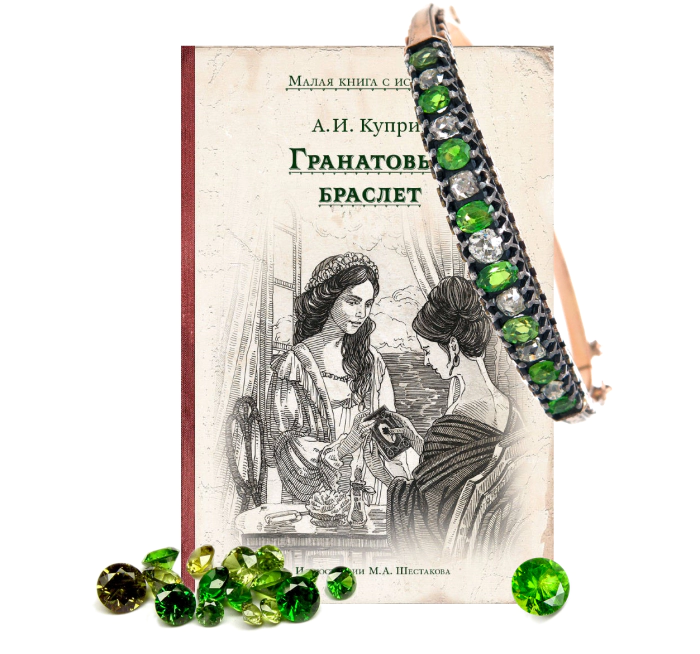
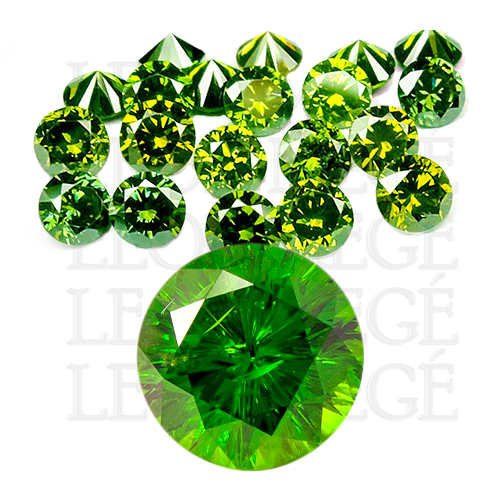
Uvarovite is a deep-green garnet that occurs as small crystals densely coating a matrix. It is the only green garnet variety with pure chromium impurities and nothing else. The garnet is a rarity that can be found in museum collections.
Uvarovite was first discovered in 1832 by Swiss chemist Germain Henri Hessnaming the new mineral after his lover, Count Sergei Uvarov, a Russian reactionary minister of education responsible for the institution of ultra-orthodox faith and Russian imperialist ideology in schools. He restricted education for commoners and tightened government control over universities.
Color change garnets exhibit a different hue depending on the type of light source – incandescent or daylight. The variety is a hybrid of the Pyrope and Spessartite that displays a color change from a light brownish, yellowish, or greenish in daylight to a pink or purplish color in incandescent light. A few rare specimens may even have a bluish color. Color-change garnets are found in Tanzania, Madagascar, Sri Lanka, and the US.
Red Garnet from the African country of Mozambique produces fine-quality Garnet gemstones. Mozambique garnets are usually Almandine, but sometimes Pyrope variety. Mozambique Garnet has a darker red tone than Rhodolites. Mozambique Garnet can vary from wonderfully transparent clarity to translucent.
Very common, inexpensive blood-red variety of garnet. Widely used in costume jewelry and Bohemian-style jewelry sold everywhere in the Czech Republic. Pyrope has been mined in the Bohemian Hills since the 16th century and reached its height of popularity in the Victorian era.
Understanding Metal Finishes Every metal finish falls into one of two categories: polished or textured.…
International Shipping The cost of international shipping is not included in the purchase price; please…
[show_post id="206111"] Buying jewelry is a compulsive act of frivolous excessive callous unnecessary spending Leon…
Engagement Ring AI There are three basic engagement ring styles: Solitaire, Halo, and three- or…
Wearing a wedding band next to an engagement ring is a cause for concern and…
Revered for their incredible beauty and mythical origins, Argyle pink diamonds are highly coveted as…
This website uses cookies.